
Loading

Search
▼ Narita Airport, Startup in Japan Demonstrate Machine to Compress Clothes for Tourists to Prevent People from Abandoning Suitcases
- Category:Other
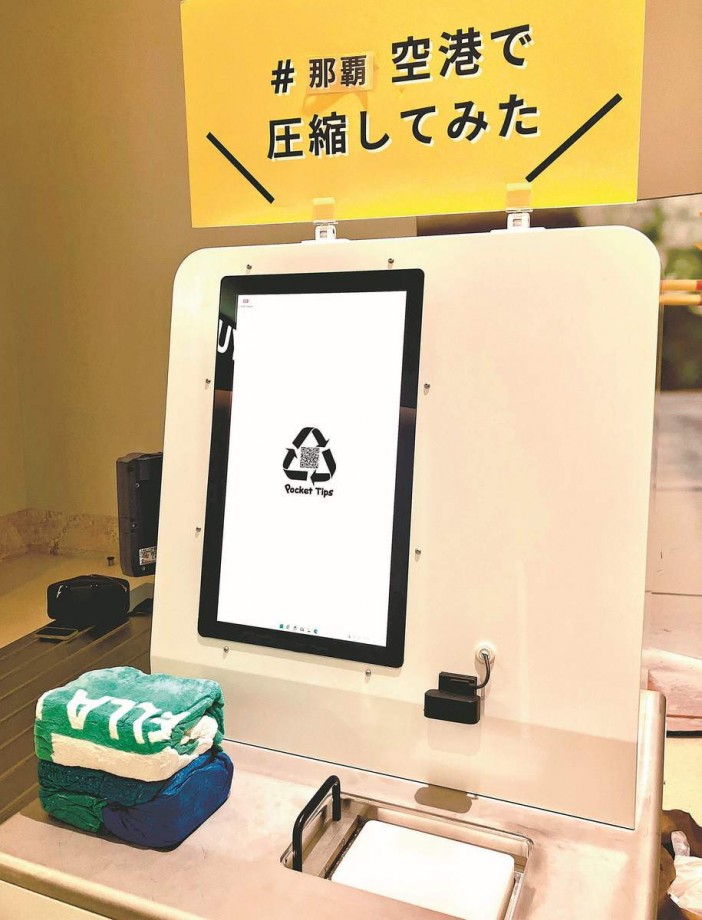
Narita International Airport Corporation (NAA) and SJOY Co., an apparel startup, jointly conducted a test of a machine to compress clothes to small sizes in the airport from Jan. 13 to 15.
There have been many cases recently in which foreign tourists have left behind old baggage in airports around Japan, and the number of abandoned suitcases has increased by about 8.5 times in the past four years.
“We hope that the introduction of the compressing machine will solve the [abandoned] suitcase problem,” an NAA official said.
The automatic compressing machine set up in the airport is called Pocket Tips, which was developed by the startup based in Koto Ward, Tokyo. SJOY was established in 2019.
Conventional compressing machines remove air from clothes in vacuum-packed storage bags. Pocket Tips, however, compresses the clothes themselves into a very small size.
“[Clothes] can become one-seventh of the maximum size and get quite small,” said Sanmi Kawaguchi, 30, the president of SJOY. “Because it doesn’t use vacuum storage bags, the sizes are not affected by changes in air pressure even during flights.”
Washing the compressed clothes can return them to the original sizes, she said.
According to NAA, the number of old suitcases being abandoned at Narita Airport has rapidly increased along with the rise in the number of inbound foreign tourists after the COVID-19 pandemic subsided.
Airport officials collected 124 abandoned suitcases in fiscal 2020. The number has steadily risen since then to 338 in fiscal 2021, 552 in fiscal 2022 and 811 in fiscal 2023. In fiscal 2024, the number climbed to 1,034.
Some of the abandoned suitcases were locked and, therefore, airport officials were unable to immediately check the contents of the baggage.
Thus, it was difficult to secure personnel for checking the inside of the suitcases and there was shortage in space where they should be stored until they were handed to police as lost-and-found items.
Airport officials believe that most of the suitcases were intentionally left behind.
This may be partially due to tourists buying new suitcases in airports and abandoning the old ones, as people bought many souvenirs and there was not enough space in the old baggage before they departed for their home countries.
The machine can compress clothes into small sizes within only about one minute. Tests of the machine were already conducted in other airports, including Haneda Airport in Tokyo, Naha Airport in Okinawa Prefecture and Kumamoto Airport in Kumamoto Prefecture.
“We have heard people say that [the machine] helped create more space inside their suitcase to hold souvenirs that were additionally bought,” said Kawaguchi.
The test at Narita Airport was conducted for the three days in its second passenger terminal mainly for international flights and the departure lobby of the third passenger terminal mainly for low-cost carriers’ flights.
The machine could be used free of charge and a survey on the users was also conducted.
Akari Saito, an official of NAA’s innovation promotion group, said: “There are passengers who gave up on buying souvenirs which they wanted because there was not enough space in their suitcase.
After examining reactions in the test, we will conduct another test with a fee to use the machine. If it proves to be effective, we will consider full-fledged introduction of it.”
There have been many cases recently in which foreign tourists have left behind old baggage in airports around Japan, and the number of abandoned suitcases has increased by about 8.5 times in the past four years.
“We hope that the introduction of the compressing machine will solve the [abandoned] suitcase problem,” an NAA official said.
The automatic compressing machine set up in the airport is called Pocket Tips, which was developed by the startup based in Koto Ward, Tokyo. SJOY was established in 2019.
Conventional compressing machines remove air from clothes in vacuum-packed storage bags. Pocket Tips, however, compresses the clothes themselves into a very small size.
“[Clothes] can become one-seventh of the maximum size and get quite small,” said Sanmi Kawaguchi, 30, the president of SJOY. “Because it doesn’t use vacuum storage bags, the sizes are not affected by changes in air pressure even during flights.”
Washing the compressed clothes can return them to the original sizes, she said.
According to NAA, the number of old suitcases being abandoned at Narita Airport has rapidly increased along with the rise in the number of inbound foreign tourists after the COVID-19 pandemic subsided.
Airport officials collected 124 abandoned suitcases in fiscal 2020. The number has steadily risen since then to 338 in fiscal 2021, 552 in fiscal 2022 and 811 in fiscal 2023. In fiscal 2024, the number climbed to 1,034.
Some of the abandoned suitcases were locked and, therefore, airport officials were unable to immediately check the contents of the baggage.
Thus, it was difficult to secure personnel for checking the inside of the suitcases and there was shortage in space where they should be stored until they were handed to police as lost-and-found items.
Airport officials believe that most of the suitcases were intentionally left behind.
This may be partially due to tourists buying new suitcases in airports and abandoning the old ones, as people bought many souvenirs and there was not enough space in the old baggage before they departed for their home countries.
The machine can compress clothes into small sizes within only about one minute. Tests of the machine were already conducted in other airports, including Haneda Airport in Tokyo, Naha Airport in Okinawa Prefecture and Kumamoto Airport in Kumamoto Prefecture.
“We have heard people say that [the machine] helped create more space inside their suitcase to hold souvenirs that were additionally bought,” said Kawaguchi.
The test at Narita Airport was conducted for the three days in its second passenger terminal mainly for international flights and the departure lobby of the third passenger terminal mainly for low-cost carriers’ flights.
The machine could be used free of charge and a survey on the users was also conducted.
Akari Saito, an official of NAA’s innovation promotion group, said: “There are passengers who gave up on buying souvenirs which they wanted because there was not enough space in their suitcase.
After examining reactions in the test, we will conduct another test with a fee to use the machine. If it proves to be effective, we will consider full-fledged introduction of it.”
- February 1, 2026
- Comment (0)
- Trackback(0)