
Loading
Search
▼ Major Companies Have Agreed to Fully Meet Wage Increases to Boost Employee Morale
- Category:Other
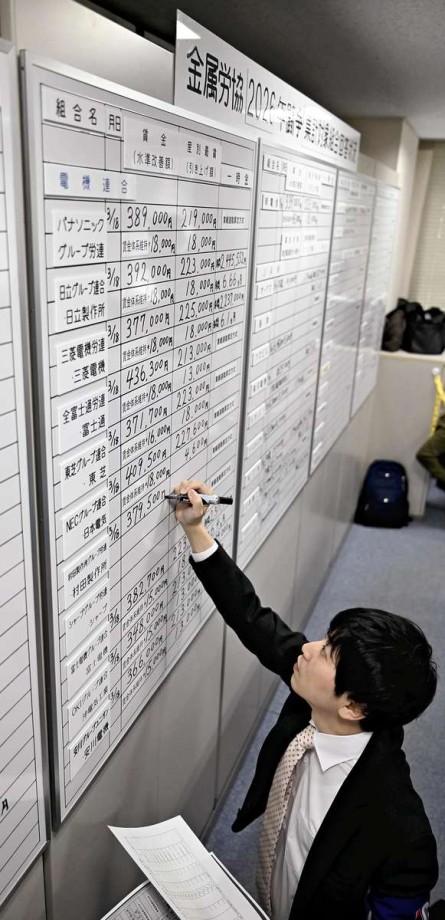
Against the backdrop of soaring prices, a number of major companies across a wide range of industries, including automobiles and electronics, fully agreed on Wednesday to high wage increases as demanded by labor unions during this year’s shunto spring wage negotiations.
Many companies apparently fully accepted pay hike demands as they prioritized employees’ morale amid a severe business environment.
However, as negotiations with small and midsize enterprises are set to begin in earnest, rising crude oil prices due to the deteriorating situation in the Middle East could negatively impact their wage increases.
The Japanese Trade Union Confederation (Rengo) has set an overall target of at least a 5% increase in this year’s negotiations. For small and midsize enterprises, the target increase is at least 6%.
According to the Japan Council of Metalworkers’ Unions, all 49 member unions representing industries including the automobile and electronics sectors received decisions by 12:30 p.m. on Wednesday. Improvements to a pay-scale increase per month for base pay had been secured. The average wage increase stands at around 5.1%.
At a press conference on the same day, Akihiro Kaneko, president of the Confederation of Japan Automobile Workers’ Unions, expressed satisfaction. “Although the environment surrounding the automobile industry is severe, I highly appreciate the fact that we were able to secure the requested level,” he said.
All seven major automakers responded with wage increases that met or exceeded the requested amounts, an improvement from 2025, when only three companies did so. The move aims to boost employees’ morale even as business performance remains sluggish due to factors such as U.S. tariffs.
Nissan Motor Co., which gave its response before Wednesday, is projected to post a net loss for the fiscal year ending March 2026, while Mazda Motor Corp. and Mitsubishi Motors Corp. also reported net losses for the April-December 2025 period.
A Mitsubishi Motors executive stated, “Precisely because the world is in turmoil, we want employees to focus on their work rather than prolonging wage negotiations.”
Honda Motor Co. also offered to fully meet the proposed amount of ¥18,500, including a ¥12,000 pay-scale raise and a regular pay increase.
The company is expected to post a net loss of up to ¥690 billion in its consolidated financial results for the fiscal year ending March 2026, mainly due to losses related to electric vehicles.
Steel sector falls short of demands
Major electronics manufacturers have reported solid performance driven mainly by increased demand for power transmission and distribution equipment as well as artificial intelligence services.
Five of the seven firms, including Hitachi, Ltd. and Mitsubishi Electric Corp., offered full-scale raises, with all companies exceeding offers from the previous year.
Mitsubishi Electric’s rate of increase, which combines a pay-scale raise and a merit-based pay increase, was 7% on average – the highest level since the current negotiation system was adopted in 2008.
Meanwhile, raises offered by major steelmakers fell short of demands for pay-scale increases due to deteriorating market conditions caused by overproduction in China.
JFE Steel Corp. responded to a demand of ¥15,000 with an offer of ¥7,000 – less than half the amount. The company had met the full ¥15,000 demand in 2025.
A public relations official from the company said: “We had anticipated an improvement in the business environment, but the severe conditions have persisted. The outlook remains uncertain.”
In response to the ¥15,000 increase demand, Nippon Steel Corp. offered ¥10,000 and Kobe Steel, Ltd. offered ¥13,000 — both lower than the previous year’s figures.
Many companies apparently fully accepted pay hike demands as they prioritized employees’ morale amid a severe business environment.
However, as negotiations with small and midsize enterprises are set to begin in earnest, rising crude oil prices due to the deteriorating situation in the Middle East could negatively impact their wage increases.
The Japanese Trade Union Confederation (Rengo) has set an overall target of at least a 5% increase in this year’s negotiations. For small and midsize enterprises, the target increase is at least 6%.
According to the Japan Council of Metalworkers’ Unions, all 49 member unions representing industries including the automobile and electronics sectors received decisions by 12:30 p.m. on Wednesday. Improvements to a pay-scale increase per month for base pay had been secured. The average wage increase stands at around 5.1%.
At a press conference on the same day, Akihiro Kaneko, president of the Confederation of Japan Automobile Workers’ Unions, expressed satisfaction. “Although the environment surrounding the automobile industry is severe, I highly appreciate the fact that we were able to secure the requested level,” he said.
All seven major automakers responded with wage increases that met or exceeded the requested amounts, an improvement from 2025, when only three companies did so. The move aims to boost employees’ morale even as business performance remains sluggish due to factors such as U.S. tariffs.
Nissan Motor Co., which gave its response before Wednesday, is projected to post a net loss for the fiscal year ending March 2026, while Mazda Motor Corp. and Mitsubishi Motors Corp. also reported net losses for the April-December 2025 period.
A Mitsubishi Motors executive stated, “Precisely because the world is in turmoil, we want employees to focus on their work rather than prolonging wage negotiations.”
Honda Motor Co. also offered to fully meet the proposed amount of ¥18,500, including a ¥12,000 pay-scale raise and a regular pay increase.
The company is expected to post a net loss of up to ¥690 billion in its consolidated financial results for the fiscal year ending March 2026, mainly due to losses related to electric vehicles.
Steel sector falls short of demands
Major electronics manufacturers have reported solid performance driven mainly by increased demand for power transmission and distribution equipment as well as artificial intelligence services.
Five of the seven firms, including Hitachi, Ltd. and Mitsubishi Electric Corp., offered full-scale raises, with all companies exceeding offers from the previous year.
Mitsubishi Electric’s rate of increase, which combines a pay-scale raise and a merit-based pay increase, was 7% on average – the highest level since the current negotiation system was adopted in 2008.
Meanwhile, raises offered by major steelmakers fell short of demands for pay-scale increases due to deteriorating market conditions caused by overproduction in China.
JFE Steel Corp. responded to a demand of ¥15,000 with an offer of ¥7,000 – less than half the amount. The company had met the full ¥15,000 demand in 2025.
A public relations official from the company said: “We had anticipated an improvement in the business environment, but the severe conditions have persisted. The outlook remains uncertain.”
In response to the ¥15,000 increase demand, Nippon Steel Corp. offered ¥10,000 and Kobe Steel, Ltd. offered ¥13,000 — both lower than the previous year’s figures.
- March 20, 2026
- Comment (0)
- Trackback(0)