
Loading

Search
▼ Stocks Slide In Japan As Strait Of Hormuz Fears Amplify Risk-Off Mood
- Category:Other
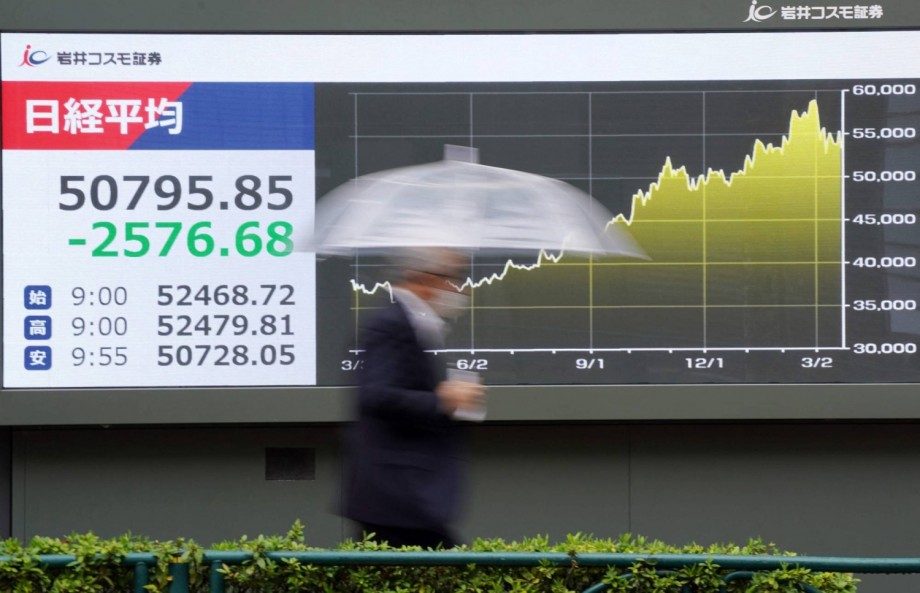
Japanese stocks dropped after U.S. President Donald Trump’s threats of attacks on power plants around the Strait of Hormuz exacerbated market concerns over climbing oil prices and fueled risk-off sentiment.
The Nikkei 225 fell as much as 5% to 50688.76 on Monday while the broader Topix slumped as much as 4.5% to 3447.34, heading for a technical correction. Tokyo’s market is catching up with global benchmarks after a public holiday on Friday.
Electronics and banks contributed most to declines on the Topix, while chip-related firms like Renesas Electronics and Lasertec were among the Nikkei’s worst performers. Skyrocketing oil prices — Brent was trading around $111 per barrel as of 10 a.m. in Tokyo — are sapping risk appetite across sectors.
"Whatever happens now, what has become crystal clear is the outlook for near term inflation," said Amir Anvarzadeh, Japan equity strategist at Asymmetric Advisors, in a note.
Trump's 48-hour ultimatum for Iran to reopen the Strait of Hormuz has "notched up the temperature," making escalation of the conflict look more likely, he added.
Anvarzadeh expects "overvalued" AI-related stocks, like cablemaker Fujikura, to be among the worst hit by inflation fears. Fujikura lost as much as 6.7% Monday.
Climbing bond yields are further amplifying caution in the equity market, said Kazuyuki Muramatsu, head of investment management at Nagomi Capital. Japan's 10-year bond yield rose six basis points to 2.32% on Monday, near its highest level since 1999.
"The market sees this as a 'bad' rise in yields," so it's a downside even for bank shares, which would usually get a tailwind from higher yields, Muramatsu said.
The Nikkei 225 fell as much as 5% to 50688.76 on Monday while the broader Topix slumped as much as 4.5% to 3447.34, heading for a technical correction. Tokyo’s market is catching up with global benchmarks after a public holiday on Friday.
Electronics and banks contributed most to declines on the Topix, while chip-related firms like Renesas Electronics and Lasertec were among the Nikkei’s worst performers. Skyrocketing oil prices — Brent was trading around $111 per barrel as of 10 a.m. in Tokyo — are sapping risk appetite across sectors.
"Whatever happens now, what has become crystal clear is the outlook for near term inflation," said Amir Anvarzadeh, Japan equity strategist at Asymmetric Advisors, in a note.
Trump's 48-hour ultimatum for Iran to reopen the Strait of Hormuz has "notched up the temperature," making escalation of the conflict look more likely, he added.
Anvarzadeh expects "overvalued" AI-related stocks, like cablemaker Fujikura, to be among the worst hit by inflation fears. Fujikura lost as much as 6.7% Monday.
Climbing bond yields are further amplifying caution in the equity market, said Kazuyuki Muramatsu, head of investment management at Nagomi Capital. Japan's 10-year bond yield rose six basis points to 2.32% on Monday, near its highest level since 1999.
"The market sees this as a 'bad' rise in yields," so it's a downside even for bank shares, which would usually get a tailwind from higher yields, Muramatsu said.
- March 23, 2026
- Comment (0)
- Trackback(0)