
Loading

Search
▼ Crop Production in Japan Shifts North, To Higher-Altitude Areas Due to Summer Heat
- Category:Other
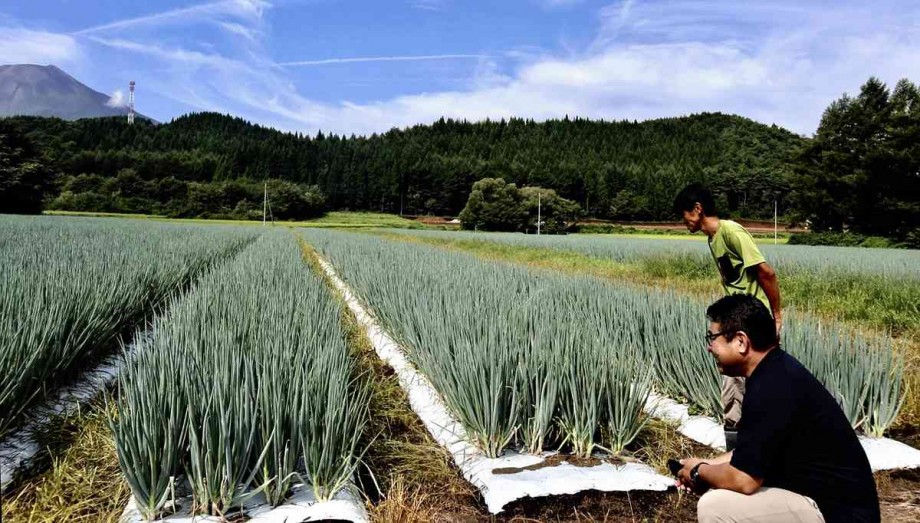
There has been a growing trend of agricultural companies shifting production to cooler regions such as northern Japan and high-altitude areas in response to increased damage to crops caused by the summer heat.
This is due to abnormal weather patterns becoming the norm in recent years, which could significantly alter the regions suitable for cultivation.
‘We’ve reached our limit’
In April, Kyoto-based agricultural corporation Koto Kyoto was to start cultivating Kujo green onions, a traditional Kyoto vegetable, in Date, Hokkaido. The company has purchased approximately 10 hectares of land and expects to harvest about 100 tons in the first season using 4 hectares.
Kujo green onions are relatively sensitive to heat, with an optimal growing temperature of 15-25 C. The average temperature in Kyoto City during July and August has reached around 30 C in recent years and last year the city saw 47 days of extreme heat with maximum temperatures exceeding 35 C.
The company reports that maintaining yields has become difficult due to poor growth caused by high temperatures.
Koto Kyoto initially cultivated the onions within Kyoto year-round, however, it has suspended summer cultivation and dispersed production to the northern and central regions of Kyoto Prefecture since 2022.
The company has expanded operations to places outside the prefecture, such as Iwate Prefecture, where it has contracted growers, and is focusing on securing yields. However, anticipating that the impact of the heat will continue to spread, the company decided to expand into Hokkaido.
“I feel we have reached the limit of summer cultivation,” said President Toshiyuki Yamada. “This is to protect our high-quality, delicious green onions.”
Date is located in southwestern Hokkaido, where the average temperature during the summer (June-September) remains around 20 C. Because the area is relatively warm and receives little snow compared to the rest of Hokkaido, it has attracted attention from agricultural corporations outside Hokkaido as a summer production base.
Accelerating diversification
Asai Nursery, Inc., an agricultural corporation producing cherry tomatoes in Mie Prefecture, also completed a 1.6-hectare greenhouse in Date in late January, investing approximately ¥1.3 billion in construction costs.
The farm expects an annual harvest of about 340 tons as a summer production base.
Adverse effects such as “poor flowering” — where flowers fail to bloom due to summer heat — and “hollow fruit” — where the flesh is extremely sparse — have become increasingly noticeable at farms in Mie Prefecture over the past four to five years.
President Yuichiro Asai, 45, says, “As the heat has become more severe year by year, the diversifying of production areas was unavoidable when forecasting the next 10 or 20 years.”
High-altitude cultivation
There is also a trend toward seeking new cultivation sites in high-altitude areas. Agricultural corporation Zebra Greens., Ltd. in Kakogawa, Hyogo Prefecture, constructed approximately 1.3 hectares of tomato greenhouses in a village at an elevation of about 600 meters in Nose, Osaka Prefecture, last year and began cultivation.
Summer temperatures there are about 5 to 6 C lower than in the surrounding plains, and nighttime temperatures — which are crucial for tomato growth — drop to near the ideal range (below 20 C). Representative Toshihiko Kakitsubo said, “Since it’s near the consumer market, we can keep shipping costs down.”
“The movement to protect agriculture through a ‘production relay,’ finding new suitable locations and ensuring uninterrupted shipments, will continue to expand,” said Yasufumi Miwa, an expert on agriculture of the Japan Research Institute.
He also pointed out that “individual and small-scale farmers, for whom relocating farmland is difficult, may be forced to quit farming, so local governments need to take the lead in promoting the development of heat-tolerant varieties and the transition to alternative crops.”
Heat-related damage
According to the Japan Meteorological Agency, high temperatures have persisted across the country since the 1990s, and last summer (June-August) saw average temperatures reach record highs for the third consecutive year.
A total of 9,385 locations saw extreme heat days with maximum temperature exceeding 35 C, with temperatures of 40 C or higher observed at 30 locations.
Heat-related damage to crops is occurring across the country. A survey by the Agriculture, Forestry and Fisheries Ministry in 2024 reported that effects consistent with heat stress were observed in 40-50% of tomato-growing regions and 30-40% of mandarin orange-growing regions nationwide.
The ministry predicts that suitable growing areas for major fruit crops such as apples and mandarin oranges will shift northward and inland in the future due to global warming.
In Hokkaido, areas being used for sweet potato cultivation has increased, and Akita Prefecture is also conducting cultivation trials of the crops.
It has been reported that due to poor coloring of ornamental cabbage from central and western Japan, the flower market has requested producers in Yamagata Prefecture to increase production.
- May 4, 2026
- Comment (0)
- Trackback(0)