
Loading

Search
▼ Japan Approves Record Defense Budget for Fiscal Year 2026
- Category:Other
The cabinet of Japanese Prime Minister Sanae Takaichi on December 26 approved $58 billion (9.04 trillion yen) defense spending for fiscal year 2026, as Tokyo faces growing military pressure from three nuclear-armed neighbors—China, North Korea, and Russia—and U.S. calls for higher defense outlays.
The draft budget represents a 3.8 percent increase from the current fiscal year, marking a record high for the 12th consecutive year.
The defense budget, expected to pass Japan’s bicameral legislature in coming months, aims to bolster unmanned defense systems and standoff missile capabilities to address the country’s deteriorating security environment.
In its defense budget, the Japan Maritime Self-Defense Force (JMSDF) secured funding for the construction of four types of JMSDF vessels, as well as the procurement of various aircraft. Key maritime-related items in the budget are as follows:
The establishment of the national multi-layered coastal defense system called “SHIELD” ($640.6 million)
The defense ministry plans to acquire an unspecified number of surface ship-launched UAVs, small ship-based UAVs, and small multi-role USVs for the JMSDF to build SHEILD. The name stands for “Synchronized, Hybrid, Integrated and Enhanced Littoral Defense.”
The ministry said the plan would involve purchasing existing UAVs and USVs, primarily from foreign manufacturers. It also said that surface-launched UAVs will attack enemy ships from JMSDF ships. Meanwhile, small ship-based UAVs will improve the intelligence gathering and surveillance capabilities of surface vessels, and will also be able to attack enemy vessels.
In July, JMSDF officials told Naval News that the U.S. aerospace and defense technology company Shield AI’s V-BAT is being considered as an UAV to be installed on the upgraded Mogami-class frigate—known in Tokyo as the “New FFM” and also called as the 06FFM.
The JMSDF has already decided to equip its new Sakura-class offshore patrol vessels (OPVs), with a standard displacement of 1,900 tons, with the V-BAT. Under the Defense Buildup Program adopted in December 2022, the MoD plans to acquire 12 OPVs over the next decade. The fiscal 2025 defense budget earmarks 4 billion yen for the procurement of six V-BAT systems for new patrol vessels.
In addition, the Defense Ministry was allocated $14.1 million to conduct demonstration tests for simultaneous control of a large number of various unmanned assets.
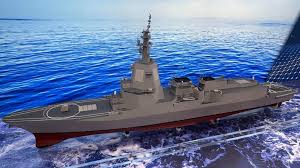
Construction of one New FFM ($667 million)
The ministry earmarked $667 million to build the sixth ship of the upgraded Mogami-class, which has a full-load displacement of about 6,200 tons. The lead ship of the New FFM class is scheduled to be laid down in fiscal year 2025 and commissioned in fiscal year 2028.
According to Mitsubishi Heavy Industries, if construction proceeds smoothly, all 12 vessels are expected to be in service by fiscal year 2032.
Securing construction costs for one New FFM in one year is very unusual because the MoD in Tokyo has so far earmarked the construction costs for two ships in the 2024 budget and three ships in the 2025 budget.
The move came as the Australian government selected the upgraded Mogami-class as the Royal Australian Navy’s future fleet of general-purpose frigates in August.
The Japanese defense ministry is believed to have prioritized near-term shipyard slots and supply-chain resources at MHI’s Nagasaki shipyard for Australia, taking into account Canberra’s urgent push to strengthen its naval capabilities.
Construction of two Sakura-class OPVs ($182.3 million)
The defense ministry was allocated $182.3 million to build the fifth and sixth ships of the new Sakura-class OPVs. The JMSDF plans to acquire a total of 12 patrol vessels over roughly 10 years.
Construction of one Taigei-class submarine($773 million)
The MoD earmarked $773 million to build the 10th Taigei-class submarine, Japan’s latest diesel-electric submarine with a displacement tonnage of 3,000 tons.
Construction of one Awaji-class minesweeper ($217.5 million)
The defense ministry was allocated $217.5 million to build the 690-tonne seventh Awaji-class minesweeper, which has improved capabilities to deal with various types of mines, including deepwater mines. The planned number of Awaji-class vessels is nine.
Preparation for various tests of two Aegis system equipped vessels – ASEVs ($510 million)
The MoD secured $510 million as expenses related to the acquisition of two Aegis system equipped vessels. Specifically, it made mention of costs associated with preparation for various tests.
The ASEVs are an alternative to the two land-based Aegis Ashore ballistic missile defense (BMD) system, which was cancelled in June 2020 over concerns that falling components from missile interceptors might hit heavily populated areas over Japan.
The defense ministry explained that the new ships will be 190 meters long, 25 meters wide, and have a standard displacement of 12,000 tons.
The JMSDF is expected to take delivery of the first ASEV during fiscal year 2027, with the second one in the following fiscal year.
Modifications of Izumo-class helicopter carriers($182.3 million)
The JMSDF earmarked $182.4 million to continue modifying its two Izumo-class helicopter carriers – JS Izumo and JS Kaga – into aircraft carriers capable of enabling Lockheed Martin F-35B fighter aircraft operations.
As for the Izumo, the defense official said $5.8 million was allocated to install deck status lights on the ship, which allow deck workers to share the status of the deck, and to cover the test cost of the landing guidance system on the Izumo.
As for the Kaga, $176.6 million was allocated for hull modifications, including upgrades to hangar facilities.
The Ministry of Defense said JS Izumo‘s modification is scheduled to be completed in fiscal 2027, and JS Kaga‘s in fiscal 2028.
According to the ministry, the cost of modifying the Izumo-class helicopter carriers, including funding in next year’s budget, will total $687.2 million.
Acquisition of the ship-launched, improved version of the Type 12 SSM ($228.4 million)
The MoD began mass production of the long-range, ship-launched, improved version of the Type 12 SSM in the current fiscal 2025.
The JMSDF will begin operating this new missile on the refurbished JS Teruzuki (DD-116) in fiscal 2027.
Acquisition of submarine-launched missiles ($102.4 million)
The MoD also began mass production of the new submarine-launched missile in the current fiscal year. It is a long-range cruise missile that can be launched from a submarine’s torpedo tubes.
The MoD explained that the missile will be installed on the JMSDF’s Taigei-class submarines.
Adding Tomahawk launch function to two Aegis destroyers ($7.7 million)
The MoD plans to equip the JMSDF’s two Aegis destroyers Myoko (DDG-175) and Atago (DDG-177) with a function to launch U.S.-made Tomahawk cruise missiles during fiscal 2026.
Defense officials said three Aegis destroyers, namely Chokai (DDG-176), Haguro (DDG-180), Kirishima (DDG-174) have already undergone for the addition of a Tomahawk launch function during this current fiscal 2025.
The JMSDF currently possesses a total of eight Aegis destroyers: four Kongo-class, two Atago-class, and two Maya-class. This means the remaining three JS Kongo (DDG-173), JS Ashigara (DDG-178) and JS Maya (DDG-179) will also be given Tomahawk capabilities in the near future.
Acquisition of four MQ-9B SkyGuardian UAVs ($489.4 million)
The defense ministry secured $489.4 million to acquire four more MQ-9B SkyGuardian UAVs for the JMSDF.
The JMSDF plans to use the SeaGuardian for persistent surveillance of surface vessels and submarines, with crewed P-1 and P-3C maritime patrol aircraft conducting anti-submarine warfare once any submarine is detected.
The JMSDF ultimately aims to acquire a total of 23 aircraft by around fiscal 2032, with roughly half to be deployed at the service’s Kanoya Air Base in Kagoshima Prefecture and the remainder at Hachinohe Air Base in Aomori Prefecture.
The draft budget represents a 3.8 percent increase from the current fiscal year, marking a record high for the 12th consecutive year.
The defense budget, expected to pass Japan’s bicameral legislature in coming months, aims to bolster unmanned defense systems and standoff missile capabilities to address the country’s deteriorating security environment.
In its defense budget, the Japan Maritime Self-Defense Force (JMSDF) secured funding for the construction of four types of JMSDF vessels, as well as the procurement of various aircraft. Key maritime-related items in the budget are as follows:
The establishment of the national multi-layered coastal defense system called “SHIELD” ($640.6 million)
The defense ministry plans to acquire an unspecified number of surface ship-launched UAVs, small ship-based UAVs, and small multi-role USVs for the JMSDF to build SHEILD. The name stands for “Synchronized, Hybrid, Integrated and Enhanced Littoral Defense.”
The ministry said the plan would involve purchasing existing UAVs and USVs, primarily from foreign manufacturers. It also said that surface-launched UAVs will attack enemy ships from JMSDF ships. Meanwhile, small ship-based UAVs will improve the intelligence gathering and surveillance capabilities of surface vessels, and will also be able to attack enemy vessels.
In July, JMSDF officials told Naval News that the U.S. aerospace and defense technology company Shield AI’s V-BAT is being considered as an UAV to be installed on the upgraded Mogami-class frigate—known in Tokyo as the “New FFM” and also called as the 06FFM.
The JMSDF has already decided to equip its new Sakura-class offshore patrol vessels (OPVs), with a standard displacement of 1,900 tons, with the V-BAT. Under the Defense Buildup Program adopted in December 2022, the MoD plans to acquire 12 OPVs over the next decade. The fiscal 2025 defense budget earmarks 4 billion yen for the procurement of six V-BAT systems for new patrol vessels.
In addition, the Defense Ministry was allocated $14.1 million to conduct demonstration tests for simultaneous control of a large number of various unmanned assets.
Construction of one New FFM ($667 million)
The ministry earmarked $667 million to build the sixth ship of the upgraded Mogami-class, which has a full-load displacement of about 6,200 tons. The lead ship of the New FFM class is scheduled to be laid down in fiscal year 2025 and commissioned in fiscal year 2028.
According to Mitsubishi Heavy Industries, if construction proceeds smoothly, all 12 vessels are expected to be in service by fiscal year 2032.
Securing construction costs for one New FFM in one year is very unusual because the MoD in Tokyo has so far earmarked the construction costs for two ships in the 2024 budget and three ships in the 2025 budget.
The move came as the Australian government selected the upgraded Mogami-class as the Royal Australian Navy’s future fleet of general-purpose frigates in August.
The Japanese defense ministry is believed to have prioritized near-term shipyard slots and supply-chain resources at MHI’s Nagasaki shipyard for Australia, taking into account Canberra’s urgent push to strengthen its naval capabilities.
Construction of two Sakura-class OPVs ($182.3 million)
The defense ministry was allocated $182.3 million to build the fifth and sixth ships of the new Sakura-class OPVs. The JMSDF plans to acquire a total of 12 patrol vessels over roughly 10 years.
Construction of one Taigei-class submarine($773 million)
The MoD earmarked $773 million to build the 10th Taigei-class submarine, Japan’s latest diesel-electric submarine with a displacement tonnage of 3,000 tons.
Construction of one Awaji-class minesweeper ($217.5 million)
The defense ministry was allocated $217.5 million to build the 690-tonne seventh Awaji-class minesweeper, which has improved capabilities to deal with various types of mines, including deepwater mines. The planned number of Awaji-class vessels is nine.
Preparation for various tests of two Aegis system equipped vessels – ASEVs ($510 million)
The MoD secured $510 million as expenses related to the acquisition of two Aegis system equipped vessels. Specifically, it made mention of costs associated with preparation for various tests.
The ASEVs are an alternative to the two land-based Aegis Ashore ballistic missile defense (BMD) system, which was cancelled in June 2020 over concerns that falling components from missile interceptors might hit heavily populated areas over Japan.
The defense ministry explained that the new ships will be 190 meters long, 25 meters wide, and have a standard displacement of 12,000 tons.
The JMSDF is expected to take delivery of the first ASEV during fiscal year 2027, with the second one in the following fiscal year.
Modifications of Izumo-class helicopter carriers($182.3 million)
The JMSDF earmarked $182.4 million to continue modifying its two Izumo-class helicopter carriers – JS Izumo and JS Kaga – into aircraft carriers capable of enabling Lockheed Martin F-35B fighter aircraft operations.
As for the Izumo, the defense official said $5.8 million was allocated to install deck status lights on the ship, which allow deck workers to share the status of the deck, and to cover the test cost of the landing guidance system on the Izumo.
As for the Kaga, $176.6 million was allocated for hull modifications, including upgrades to hangar facilities.
The Ministry of Defense said JS Izumo‘s modification is scheduled to be completed in fiscal 2027, and JS Kaga‘s in fiscal 2028.
According to the ministry, the cost of modifying the Izumo-class helicopter carriers, including funding in next year’s budget, will total $687.2 million.
Acquisition of the ship-launched, improved version of the Type 12 SSM ($228.4 million)
The MoD began mass production of the long-range, ship-launched, improved version of the Type 12 SSM in the current fiscal 2025.
The JMSDF will begin operating this new missile on the refurbished JS Teruzuki (DD-116) in fiscal 2027.
Acquisition of submarine-launched missiles ($102.4 million)
The MoD also began mass production of the new submarine-launched missile in the current fiscal year. It is a long-range cruise missile that can be launched from a submarine’s torpedo tubes.
The MoD explained that the missile will be installed on the JMSDF’s Taigei-class submarines.
Adding Tomahawk launch function to two Aegis destroyers ($7.7 million)
The MoD plans to equip the JMSDF’s two Aegis destroyers Myoko (DDG-175) and Atago (DDG-177) with a function to launch U.S.-made Tomahawk cruise missiles during fiscal 2026.
Defense officials said three Aegis destroyers, namely Chokai (DDG-176), Haguro (DDG-180), Kirishima (DDG-174) have already undergone for the addition of a Tomahawk launch function during this current fiscal 2025.
The JMSDF currently possesses a total of eight Aegis destroyers: four Kongo-class, two Atago-class, and two Maya-class. This means the remaining three JS Kongo (DDG-173), JS Ashigara (DDG-178) and JS Maya (DDG-179) will also be given Tomahawk capabilities in the near future.
Acquisition of four MQ-9B SkyGuardian UAVs ($489.4 million)
The defense ministry secured $489.4 million to acquire four more MQ-9B SkyGuardian UAVs for the JMSDF.
The JMSDF plans to use the SeaGuardian for persistent surveillance of surface vessels and submarines, with crewed P-1 and P-3C maritime patrol aircraft conducting anti-submarine warfare once any submarine is detected.
The JMSDF ultimately aims to acquire a total of 23 aircraft by around fiscal 2032, with roughly half to be deployed at the service’s Kanoya Air Base in Kagoshima Prefecture and the remainder at Hachinohe Air Base in Aomori Prefecture.
- December 30, 2025
- Comment (0)
- Trackback(0)