
Loading

Search
▼ Taiwan And Japan Express Concern About China’s Military Activities
- Category:Event
Taiwan and Japan expressed concern on Friday about China’s military activities in the region, after Reuters news agency revealed that Beijing had deployed a large number of vessels in East Asian waters this week, in its biggest show of maritime force to date.
Reuters reported on Thursday (4) that China was deploying a large number of Navy and coast guard ships in East Asian waters — at one point, more than 100 — citing sources and intelligence reports reviewed by the agency.
Speaking to the press in Taipei, Taiwanese presidential spokeswoman Karen Kuo stated that Chinese activity is not limited to the Taiwan Strait, but extends from the Yellow Sea to the waters near the disputed Senkaku Islands, in the East China Sea, entering the South China Sea and the Western Pacific.
“This does indeed pose a threat and an impact to the Indo-Pacific and the entire region,” she said. “We especially call on China to fulfill its responsibilities as a great power and show restraint in its actions.”
Kuo said Taiwan President Lai Ching-te has instructed security forces to maintain full situational awareness and provide timely updates.
Taiwan will maintain close contact and cooperation with unspecified “friendly partners” to jointly safeguard peace and stability in the Indo-Pacific, she said.
In Tokyo, Defense Minister Shinjiro Koizumi, asked about Chinese activity in the East China Sea, said that Japan was aware of the reports and was following Chinese military movements “with great attention”, although he refused to comment on the specific situation.
“China has been expanding and intensifying its military activities in the areas around Japan, and we constantly strive to collect and analyze information about Chinese military movements very carefully,” he told reporters, without specifying a specific period of Chinese activities.
“In any case, the government will continue to monitor developments around Japan with deep concern and will do everything possible to ensure thorough intelligence gathering and surveillance,” the defense minister continued.
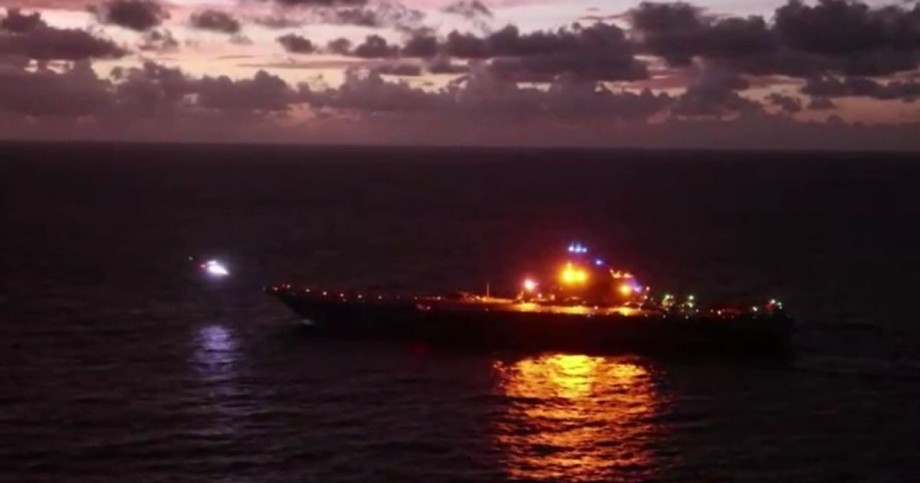
Chinese Navy in military exercise in the South China Sea • STR/AFP/Getty Images
China’s Armed Forces did not comment, but Lin Jian, spokesperson for the Chinese Foreign Ministry, said the Navy and Coast Guard’s activities in “relevant maritime areas” strictly follow national and international laws.
“There is no need for either party to overreact, misinterpret or engage in baseless speculation,” he said in Beijing.
November and December are traditionally months of intense military activity in China, although the People’s Liberation Army has not announced any large-scale exercises with an official name.
The operations surpass China’s major naval deployment in December last year, which prompted Taiwan to raise its alert level, sources reported.
The increase in activity comes amid a , after Japanese Prime Minister Sanae Takaichi declared last month that a hypothetical Chinese attack on democratically-ruled Taiwan could trigger a military response from Tokyo.
Beijing was also angered by Taiwan President Lai Ching-te’s announcement last month of a , which considers the island as its own territory, despite Taiwan’s strong rejection.
Reuters reported on Thursday (4) that China was deploying a large number of Navy and coast guard ships in East Asian waters — at one point, more than 100 — citing sources and intelligence reports reviewed by the agency.
Speaking to the press in Taipei, Taiwanese presidential spokeswoman Karen Kuo stated that Chinese activity is not limited to the Taiwan Strait, but extends from the Yellow Sea to the waters near the disputed Senkaku Islands, in the East China Sea, entering the South China Sea and the Western Pacific.
“This does indeed pose a threat and an impact to the Indo-Pacific and the entire region,” she said. “We especially call on China to fulfill its responsibilities as a great power and show restraint in its actions.”
Kuo said Taiwan President Lai Ching-te has instructed security forces to maintain full situational awareness and provide timely updates.
Taiwan will maintain close contact and cooperation with unspecified “friendly partners” to jointly safeguard peace and stability in the Indo-Pacific, she said.
In Tokyo, Defense Minister Shinjiro Koizumi, asked about Chinese activity in the East China Sea, said that Japan was aware of the reports and was following Chinese military movements “with great attention”, although he refused to comment on the specific situation.
“China has been expanding and intensifying its military activities in the areas around Japan, and we constantly strive to collect and analyze information about Chinese military movements very carefully,” he told reporters, without specifying a specific period of Chinese activities.
“In any case, the government will continue to monitor developments around Japan with deep concern and will do everything possible to ensure thorough intelligence gathering and surveillance,” the defense minister continued.
Chinese Navy in military exercise in the South China Sea • STR/AFP/Getty Images
China’s Armed Forces did not comment, but Lin Jian, spokesperson for the Chinese Foreign Ministry, said the Navy and Coast Guard’s activities in “relevant maritime areas” strictly follow national and international laws.
“There is no need for either party to overreact, misinterpret or engage in baseless speculation,” he said in Beijing.
November and December are traditionally months of intense military activity in China, although the People’s Liberation Army has not announced any large-scale exercises with an official name.
The operations surpass China’s major naval deployment in December last year, which prompted Taiwan to raise its alert level, sources reported.
The increase in activity comes amid a , after Japanese Prime Minister Sanae Takaichi declared last month that a hypothetical Chinese attack on democratically-ruled Taiwan could trigger a military response from Tokyo.
Beijing was also angered by Taiwan President Lai Ching-te’s announcement last month of a , which considers the island as its own territory, despite Taiwan’s strong rejection.
- December 5, 2025
- Comment (0)
- Trackback(0)