

▼ Do You Really Need To Learn Japanese To Live In Japan?
- Category:Experience

In late April, the New York Times Books section posted a tweet that set off a firestorm of debate and condemnation about whether or not a long-term foreign resident of Japan should actually have to learn Japanese if they live in the country.
The tweet in question linked to a review in the New York Times of Pico Iyer's new book, Autumn Light. Iyer is a well-known essayist and travel writer who has lived in Japan off-and-on for the past twenty-five years.
The debate touched on matters such as Orientalism and how Japan has traditionally been portrayed by Western writers, the status of women in intercultural marriages and the unpaid labour that foreign-born men often rely on simply in order to function from day to day in Japan, and the hierarchy that exists in the foreigner community in Japan.
According to Iyer's publisher, the new book is intended to be “a far-reaching exploration of Japanese history and culture and a moving meditation on impermanence, mortality, and grief.”
It's unlikely that many people on Twitter actually read handthe New York Times review of Iyer's book. Most of the 290-some-odd replies to the original tweet, as well as a number of conversations among “foreign-residents-of-Japan Twitter” focused on Iyer's never having learned to speak Japanese despite having lived in the country for a long, long time.
Others commented on the anonymity of Iyer's “Japanese wife” who, presumably makes sure Iyer can live his life easily in Japan.
As an on-and-off foreign resident of Japan who has invested a significant amount of time learning Japanese and just trying to fit in, I was irritated by the New York Times Books tweet as well. I left a few comments on Twitter expressing my own disgust with Iyer's supposed attitudes about Japan, although I generally refrain from criticizing fellow writers and residents of Japan in public.
The community of long-term foreign residents in Japan active on social media is pretty small, and the number of foreign residents writing about the country is smaller still. A disparaging remark can set up a social media feud that never ends.
On top of that, there is a small but significant number of long-term foreign residents of Japan (some of whom have naturalized and have become Japanese citizens) who stalk and harass journalists, academics and other writers who have the “wrong” opinions about Japan. It's a toxic culture that I've experienced first-hand writing about Japan at Global Voices, and that I don't want to participate in.
And yet still I left comments here and there expressing my irritation with Pico Iyer.
Why does Pico Iyer's refusal to learn Japanese inspire such vitriol? One reason could be that almost every non-Japanese Westerner who spends time in Japan feels both a sense of accomplishment for mastering simple tasks such as reading a train timetable or ordering from a restaurant menu, and a sense of disdain for other foreign visitors or residents who have not.
Not every long-term foreign resident of Japan has the time and energy to master the Japanese language, which makes it easy for those of us who can speak and read Japanese to feel smugly superior (although, in the foreign hierarchy of Japan, there is always someone who has achieved an even higher mastery of Japanese than you, and who can therefore feel even more smugly superior).
It also takes a lot of time and effort for a Westerner to establish a life in Japan. Besides learning approximately 1,800 Chinese characters and mastering 10,000 words, foreign-born residents of Japan have to become near-experts on an almost infinite number of subjects, including etiquette, tax law, history, food, and the importance of always possessing a pocket handkerchief (public lavatories almost never have paper towels for drying one's’ hands).
Doing the hard work of fitting in and making a life in the country results in a sort of feeling of ownership of the country and the culture: “How would you know anything about Japan? You don't even know the rules that govern municipal election campaigning!” (This is a real criticism I actually received recently from another long-termer trying to put me in my place.)
There's also something protective about the “long-termer” reaction to how others write about Japan. Tired tropes regularly reported in Western media about how Japanese people are not having sex or how the destroyed nuclear power plants at Fukushima are poisoning the Pacific are almost obsessively derided and debunked on Twitter and Facebook.
Twitter user @deivudesu has parodied the complicated social hierarchy of foreigners in Japan in a widely-shared diagram that, in spite of being tongue-in-cheek, shows just how much status matters.
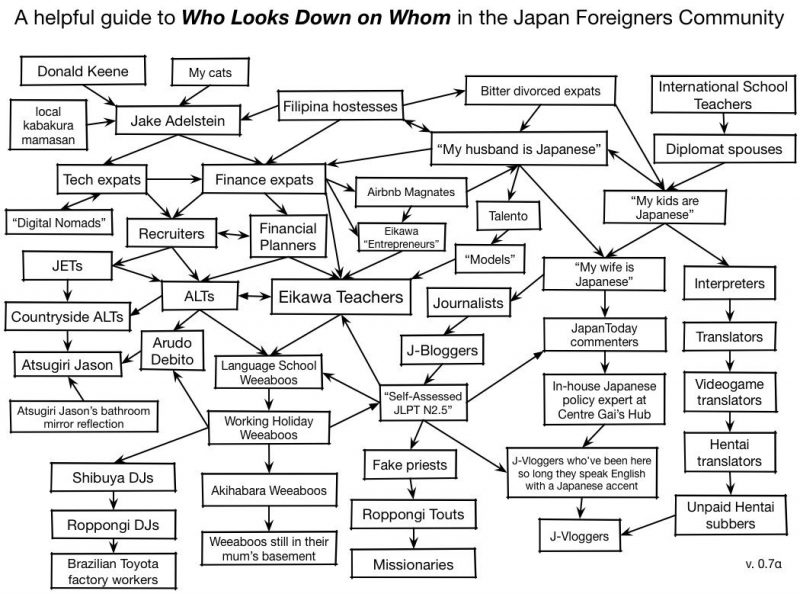
Yet the more hard-won the lessons we learn about the country, the more some of us realize how mundane life in Japan actually is. Specialty Kitkat chocolate bars, vending machines, Zen temples, and capsule hotels and trains that run on time are all just background noise and are totally unremarkable. Fax machines are actually still regularly used in many countries around the world, and not just in Japan. It's actually quite straightforward to take part in a supposedly insular culture.
Do you really need to learn Japanese to live in Japan? Like anything else in life, the correct answer to this question is entirely personal. At the end of the day, no matter where in the world you live, it's totally up to the individual whether life is mundane, rich with variety, or mysterious.
- May 7, 2019
- Comment (2506)
- Trackback(0)
Comment(s) Write comment
For many enthusiasts in the Canada, discovering a secure betting site remains a key goal. The market is vast, but <a href="https://casinonair.com/online-casino-canada">best online casino canada fast payout</a> stands out because of its solid reputation. Users typically look for a blend of safety and entertainment, which is exactly what a quality platform should offer.
-
TryvarPrick Web Site
- 28/8 12:24
Mobile progress permits players to enjoy the real gambling vibe from anywhere, [url=https://onlinecasinonodepositbonus.us/casino-online-australia]best aussie casinos[/url] features mobile compatibility accessible via all major devices. It is simple to place bets via your mobile, ensuring the excitement never stops.
Searching for the best gaming platform takes time, especially for players from the Australia. There are countless gambling sites available, however, only a few are truly reliable. We compiled a selection of top-rated sites for real money gaming.
[url=http://pocherparts.de/cgi-bin/gast4.cgi/t.me/angebot.html]New australia real money online casinos g26xgg[/url] 045dd06
-
StiphenArege Web Site
- 28/8 12:18
Honestly this was a good read, no jargon and no padding, and a short look at <a href="http://darktales.shop" />darktales</a> kept that same feel going which I really appreciated, the writer clearly knows the topic well enough to explain it without hiding behind big words or filler that often gets used to seem clever.
-
Damoncaf Web Site
- 28/8 12:09
Found the writing surprisingly fresh for what is by now a well covered topic, and a stop at <a href="http://villatravel.shop" />villatravel</a> kept that freshness going across the related pages, original perspective on familiar ground is hard to come by and this site has clearly earned its place in the conversation rather than just rehashing old ideas.
-
GermanHex Web Site
- 28/8 12:09
Better than the average post on this subject by some distance, and a look at <a href="http://webcube.shop" />webcube</a> reinforced that, you can tell within the first paragraph that the writer here actually cares about the topic rather than just covering it for the sake of having something to publish that week or that day.
-
Forrestwoorb Web Site
- 28/8 12:01
Closed the tab and immediately reopened it ten minutes later because I wanted to reread a part, and a stop at <a href="http://blog44hand.shop" />blog44hand</a> drew the same return, content that pulls you back after closing it is doing something well beyond the average and worth marking as exceptional in my mental catalogue of reliable sites.
-
BrysonKag Web Site
- 28/8 11:56
Found this through a search that was generic enough I did not expect quality results, and a look at <a href="http://telehealthtools.shop" />telehealthtools</a> continued the surprisingly good experience, search engines occasionally still surface excellent independent content if you scroll past the obvious paid and high authority results which is reassuring to remember sometimes.
-
Jadensof Web Site
- 28/8 11:36
Just wanted to drop a quick note saying this was a useful read on a topic I have been circling, no fluff, and a stop at <a href="http://truereach.shop" />truereach</a> added a few extra points that fit the same simple style which makes the whole site feel coherent rather than thrown together by many different writers with different goals.
-
Xavierchaks Web Site
- 28/8 11:29
Useful enough to recommend to several people I know who would appreciate it, and a stop at <a href="http://blog44hard.shop" />blog44hard</a> added more material I will pass along too, the kind of writing that earns word of mouth is the kind that actually delivers on its promises which is what this site does without any drama or fanfare attached.
-
Damonfrers Web Site
- 28/8 11:12
A thoughtful read in a week that has been mostly noisy, and a look at <a href="http://prosperit.shop" />prosperit</a> carried that thoughtful quality across more pages, finding pockets of considered writing in a week of distractions is one of the small wins of careful curation and this site is providing those pockets at a sustainable rate.
-
RudolphAdado Web Site
- 28/8 10:51
Refreshing change from the usual sites covering this topic, no clickbait and no padding, and a stop at <a href="http://modernmarble.shop" />modernmarble</a> confirmed the difference, this place clearly has its own voice rather than copying the formulas everyone else uses to chase clicks online which is becoming increasingly rare these days across nearly every popular subject.
-
GingerPluct Web Site
- 28/8 10:22
Will be passing this along to a few people who would benefit from the perspective shared here, and a stop at <a href="http://stackspoty.shop" />stackspoty</a> only added to what I will be sharing, this kind of generous content deserves to circulate widely rather than getting buried in some search engine algorithm tweak that pushes it down the rankings.
-
JohnnyTeelo Web Site
- 28/8 10:22
Reading this between two meetings turned out to be the highlight of the morning, and a stop at <a href="http://echostack.shop" />echostack</a> continued that highlight quality, content that outshines the structured parts of a working day is doing something well beyond ordinary and this site has produced multiple such highlights for me already this week alone.
-
Nicoinvar Web Site
- 28/8 09:36
Innovation enables players to experience the real gambling vibe on the go, <a href="https://casinosonlinenew.com/online-casino-canada">online casino slots canada</a> features mobile compatibility working on all smartphones and tablets. Gaming is seamless via your mobile, ensuring the fun continues 24/7.
-
TryvarPrick Web Site
- 28/8 09:19
KalenBut Web Site- 28/8 12:37