

▼ Do You Really Need To Learn Japanese To Live In Japan?
- Category:Experience

In late April, the New York Times Books section posted a tweet that set off a firestorm of debate and condemnation about whether or not a long-term foreign resident of Japan should actually have to learn Japanese if they live in the country.
The tweet in question linked to a review in the New York Times of Pico Iyer's new book, Autumn Light. Iyer is a well-known essayist and travel writer who has lived in Japan off-and-on for the past twenty-five years.
The debate touched on matters such as Orientalism and how Japan has traditionally been portrayed by Western writers, the status of women in intercultural marriages and the unpaid labour that foreign-born men often rely on simply in order to function from day to day in Japan, and the hierarchy that exists in the foreigner community in Japan.
According to Iyer's publisher, the new book is intended to be “a far-reaching exploration of Japanese history and culture and a moving meditation on impermanence, mortality, and grief.”
It's unlikely that many people on Twitter actually read handthe New York Times review of Iyer's book. Most of the 290-some-odd replies to the original tweet, as well as a number of conversations among “foreign-residents-of-Japan Twitter” focused on Iyer's never having learned to speak Japanese despite having lived in the country for a long, long time.
Others commented on the anonymity of Iyer's “Japanese wife” who, presumably makes sure Iyer can live his life easily in Japan.
As an on-and-off foreign resident of Japan who has invested a significant amount of time learning Japanese and just trying to fit in, I was irritated by the New York Times Books tweet as well. I left a few comments on Twitter expressing my own disgust with Iyer's supposed attitudes about Japan, although I generally refrain from criticizing fellow writers and residents of Japan in public.
The community of long-term foreign residents in Japan active on social media is pretty small, and the number of foreign residents writing about the country is smaller still. A disparaging remark can set up a social media feud that never ends.
On top of that, there is a small but significant number of long-term foreign residents of Japan (some of whom have naturalized and have become Japanese citizens) who stalk and harass journalists, academics and other writers who have the “wrong” opinions about Japan. It's a toxic culture that I've experienced first-hand writing about Japan at Global Voices, and that I don't want to participate in.
And yet still I left comments here and there expressing my irritation with Pico Iyer.
Why does Pico Iyer's refusal to learn Japanese inspire such vitriol? One reason could be that almost every non-Japanese Westerner who spends time in Japan feels both a sense of accomplishment for mastering simple tasks such as reading a train timetable or ordering from a restaurant menu, and a sense of disdain for other foreign visitors or residents who have not.
Not every long-term foreign resident of Japan has the time and energy to master the Japanese language, which makes it easy for those of us who can speak and read Japanese to feel smugly superior (although, in the foreign hierarchy of Japan, there is always someone who has achieved an even higher mastery of Japanese than you, and who can therefore feel even more smugly superior).
It also takes a lot of time and effort for a Westerner to establish a life in Japan. Besides learning approximately 1,800 Chinese characters and mastering 10,000 words, foreign-born residents of Japan have to become near-experts on an almost infinite number of subjects, including etiquette, tax law, history, food, and the importance of always possessing a pocket handkerchief (public lavatories almost never have paper towels for drying one's’ hands).
Doing the hard work of fitting in and making a life in the country results in a sort of feeling of ownership of the country and the culture: “How would you know anything about Japan? You don't even know the rules that govern municipal election campaigning!” (This is a real criticism I actually received recently from another long-termer trying to put me in my place.)
There's also something protective about the “long-termer” reaction to how others write about Japan. Tired tropes regularly reported in Western media about how Japanese people are not having sex or how the destroyed nuclear power plants at Fukushima are poisoning the Pacific are almost obsessively derided and debunked on Twitter and Facebook.
Twitter user @deivudesu has parodied the complicated social hierarchy of foreigners in Japan in a widely-shared diagram that, in spite of being tongue-in-cheek, shows just how much status matters.
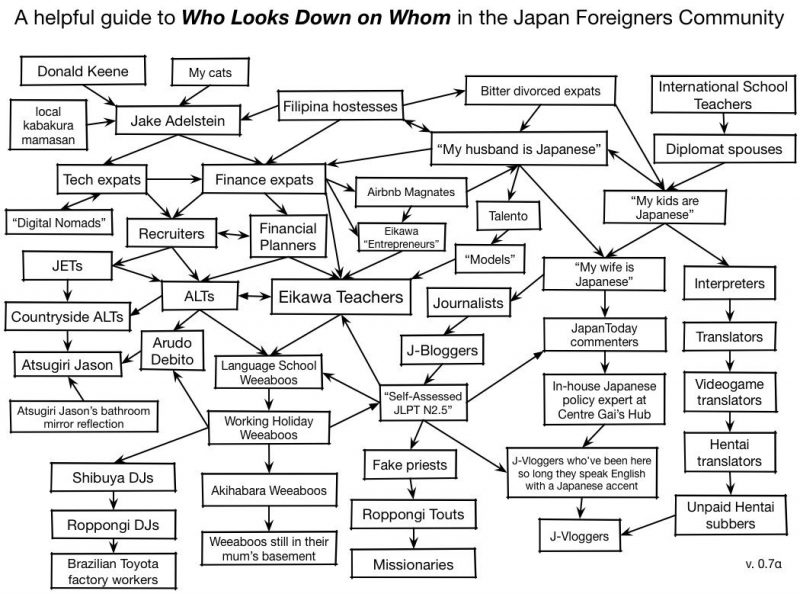
Yet the more hard-won the lessons we learn about the country, the more some of us realize how mundane life in Japan actually is. Specialty Kitkat chocolate bars, vending machines, Zen temples, and capsule hotels and trains that run on time are all just background noise and are totally unremarkable. Fax machines are actually still regularly used in many countries around the world, and not just in Japan. It's actually quite straightforward to take part in a supposedly insular culture.
Do you really need to learn Japanese to live in Japan? Like anything else in life, the correct answer to this question is entirely personal. At the end of the day, no matter where in the world you live, it's totally up to the individual whether life is mundane, rich with variety, or mysterious.
- May 7, 2019
- Comment (2507)
- Trackback(0)
Comment(s) Write comment
Now recognising the specific pleasure of reading writing that shows real care for sentence shapes, and a look at <a href="http://cocoabasil.shop" />cocoabasil</a> extended that craft pleasure, sentence level writing quality is something most blog content ignores entirely and this site has clearly invested in the prose layer alongside the substance which is rare today.
-
AlvinSiz Web Site
- June 28, 2026
Probably this is one of the better quiet successes on the open web at the moment, and a look at <a href="http://shoreskipper.shop" />shoreskipper</a> reinforced that quiet success quality, sites that are doing well without making a noise about doing well are the sites I most respect and this one has clearly chosen the quiet success path consistently throughout.
-
Kurtpresy Web Site
- June 28, 2026
Beyond the immediate post itself the editorial sensibility behind the site is what struck me, and a stop at <a href="http://urbanpickzone.shop" />urbanpickzone</a> continued displaying that sensibility, content that reveals editorial choices through accumulated reading is content with structural quality and this site has clearly developed an underlying approach worth identifying through multiple sessions of reading.
-
Kalenreows Web Site
- June 28, 2026
If I had to summarise the editorial sensibility of this site in a few words it would be careful and human, and a look at <a href="http://biablur.shop" />biablur</a> extended that summary feeling, capturing the essence of a sites approach in brief is hard but this site has a clear enough identity that the summary comes naturally enough.
-
Willisseexy Web Site
- June 28, 2026
A piece that suggested careful editing without showing the marks of the editing, and a look at <a href="http://jovigrove.shop" />jovigrove</a> continued that invisible polish, the best editing disappears into the prose and this site reads as having been edited with skill that does not announce itself which is the highest compliment I can offer any blog content.
-
Tadgar Web Site
- June 28, 2026
Took the time to read the comments on this post too and they were also worth reading, and a stop at <a href="http://tapetoken.shop" />tapetoken</a> suggested the community quality matches the content quality, when the conversation around a piece is as good as the piece itself you know you have found a real corner of the internet.
-
EmmettTon Web Site
- June 28, 2026
Thank you for keeping the writing honest and the points easy to verify against your own experience, and a stop at <a href="http://sharesignal.shop" />sharesignal</a> reflected the same approach, no exaggeration just steady useful content that I can take with me into my own work without second guessing every sentence I happen to read here.
-
Cainshozy Web Site
- June 28, 2026
Glad I stumbled across this post, the explanations actually make sense without needing background knowledge to follow along, and after a stop at <a href="http://falconbasil.shop" />falconbasil</a> the same was true there, no assumptions about the reader just clear writing that anyone can understand from the first line right through to the end.
-
IgnacioElipt Web Site
- June 28, 2026
A piece that left me thinking I had been undercaring about the topic, and a look at <a href="http://copperharborcommercegallery.shop" />copperharborcommercegallery</a> reinforced that mild concern, content that raises the appropriate weight of a subject without being preachy about it is doing important work and this site is providing that gentle elevation of attention for me consistently.
-
Billysilla Web Site
- June 28, 2026
Skipped breakfast still reading this and finished hungry but satisfied, and a stop at <a href="http://garnetcinder.shop" />garnetcinder</a> kept me past breakfast time, content that displaces basic biological needs is content with serious attentional pull and the writers here are clearly capable of producing that level of engagement which is genuinely impressive these days.
-
ErickGeD Web Site
- June 28, 2026
Genuinely changed how I think about a small piece of the topic, which does not happen often online, and a look at <a href="http://bronzecrater.shop" />bronzecrater</a> added another nudge in the same direction, the kind of writing that earns a small mental shift rather than just confirming what you already thought before reading is a sign of careful thought.
-
GarrettSlist Web Site
- June 28, 2026
My time on this site has now extended past what I had budgeted, and a stop at <a href="http://crocusgrouse.shop" />crocusgrouse</a> keeps extending it further, content that overstays its budget in my schedule is content that has earned the extra time and this site has been earning extra time across multiple visits to the point where my schedule needs adjustment.
-
Jadonweamy Web Site
- June 28, 2026
A particular kind of restraint shows up in the writing, and a look at <a href="http://lemonlarkartisanexchange.shop" />lemonlarkartisanexchange</a> maintained the same restraint across pages, knowing what not to say is just as important as knowing what to say and this site has clearly developed strong instincts on both sides of that editorial line throughout pieces I have read.
-
SeanPer Web Site
- June 28, 2026
Well crafted post, the structure flows naturally from one point to the next without forcing transitions, and a stop at <a href="http://solosupple.shop" />solosupple</a> kept the same flow going, you can tell when a writer has thought about how their content reads rather than just what it contains and this is one of those examples.
-
Davedes Web Site
- June 28, 2026
Kalennok Web Site- June 28, 2026