

▼ Do You Really Need To Learn Japanese To Live In Japan?
- Category:Experience

In late April, the New York Times Books section posted a tweet that set off a firestorm of debate and condemnation about whether or not a long-term foreign resident of Japan should actually have to learn Japanese if they live in the country.
The tweet in question linked to a review in the New York Times of Pico Iyer's new book, Autumn Light. Iyer is a well-known essayist and travel writer who has lived in Japan off-and-on for the past twenty-five years.
The debate touched on matters such as Orientalism and how Japan has traditionally been portrayed by Western writers, the status of women in intercultural marriages and the unpaid labour that foreign-born men often rely on simply in order to function from day to day in Japan, and the hierarchy that exists in the foreigner community in Japan.
According to Iyer's publisher, the new book is intended to be “a far-reaching exploration of Japanese history and culture and a moving meditation on impermanence, mortality, and grief.”
It's unlikely that many people on Twitter actually read handthe New York Times review of Iyer's book. Most of the 290-some-odd replies to the original tweet, as well as a number of conversations among “foreign-residents-of-Japan Twitter” focused on Iyer's never having learned to speak Japanese despite having lived in the country for a long, long time.
Others commented on the anonymity of Iyer's “Japanese wife” who, presumably makes sure Iyer can live his life easily in Japan.
As an on-and-off foreign resident of Japan who has invested a significant amount of time learning Japanese and just trying to fit in, I was irritated by the New York Times Books tweet as well. I left a few comments on Twitter expressing my own disgust with Iyer's supposed attitudes about Japan, although I generally refrain from criticizing fellow writers and residents of Japan in public.
The community of long-term foreign residents in Japan active on social media is pretty small, and the number of foreign residents writing about the country is smaller still. A disparaging remark can set up a social media feud that never ends.
On top of that, there is a small but significant number of long-term foreign residents of Japan (some of whom have naturalized and have become Japanese citizens) who stalk and harass journalists, academics and other writers who have the “wrong” opinions about Japan. It's a toxic culture that I've experienced first-hand writing about Japan at Global Voices, and that I don't want to participate in.
And yet still I left comments here and there expressing my irritation with Pico Iyer.
Why does Pico Iyer's refusal to learn Japanese inspire such vitriol? One reason could be that almost every non-Japanese Westerner who spends time in Japan feels both a sense of accomplishment for mastering simple tasks such as reading a train timetable or ordering from a restaurant menu, and a sense of disdain for other foreign visitors or residents who have not.
Not every long-term foreign resident of Japan has the time and energy to master the Japanese language, which makes it easy for those of us who can speak and read Japanese to feel smugly superior (although, in the foreign hierarchy of Japan, there is always someone who has achieved an even higher mastery of Japanese than you, and who can therefore feel even more smugly superior).
It also takes a lot of time and effort for a Westerner to establish a life in Japan. Besides learning approximately 1,800 Chinese characters and mastering 10,000 words, foreign-born residents of Japan have to become near-experts on an almost infinite number of subjects, including etiquette, tax law, history, food, and the importance of always possessing a pocket handkerchief (public lavatories almost never have paper towels for drying one's’ hands).
Doing the hard work of fitting in and making a life in the country results in a sort of feeling of ownership of the country and the culture: “How would you know anything about Japan? You don't even know the rules that govern municipal election campaigning!” (This is a real criticism I actually received recently from another long-termer trying to put me in my place.)
There's also something protective about the “long-termer” reaction to how others write about Japan. Tired tropes regularly reported in Western media about how Japanese people are not having sex or how the destroyed nuclear power plants at Fukushima are poisoning the Pacific are almost obsessively derided and debunked on Twitter and Facebook.
Twitter user @deivudesu has parodied the complicated social hierarchy of foreigners in Japan in a widely-shared diagram that, in spite of being tongue-in-cheek, shows just how much status matters.
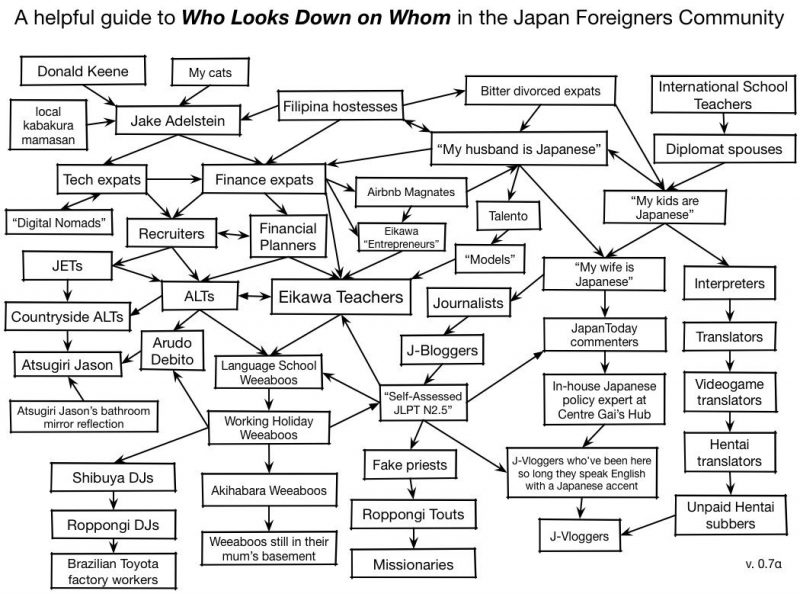
Yet the more hard-won the lessons we learn about the country, the more some of us realize how mundane life in Japan actually is. Specialty Kitkat chocolate bars, vending machines, Zen temples, and capsule hotels and trains that run on time are all just background noise and are totally unremarkable. Fax machines are actually still regularly used in many countries around the world, and not just in Japan. It's actually quite straightforward to take part in a supposedly insular culture.
Do you really need to learn Japanese to live in Japan? Like anything else in life, the correct answer to this question is entirely personal. At the end of the day, no matter where in the world you live, it's totally up to the individual whether life is mundane, rich with variety, or mysterious.
- May 7, 2019
- Comment (2506)
- Trackback(0)
Comment(s) Write comment
Picked this for my morning read because the topic seemed worth the time, and a look at <a href="http://bondedprime.bond" />bondedprime</a> confirmed the choice was right, my morning reading slot is precious and giving it to this site felt like a good investment rather than a waste which is a higher endorsement than I usually offer for content.
-
GunnerWaype Web Site
- 20/7 09:31
Solid post, the structure is easy to follow and the language stays simple even when the topic gets a bit more involved, and a look at <a href="http://securebonding.bond" />securebonding</a> kept that same standard going, so I left feeling like the time spent here was actually worth something for once which is rare lately.
-
Santiagonut Web Site
- 20/7 09:29
Worth flagging this site to a few specific friends who would appreciate the editorial sensibility, and a look at <a href="http://motionoptimizer.bond" />motionoptimizer</a> added more pages I will mention to them, recommending sites to specific people requires understanding both the site and the person and this site is making those personalised recommendations easy and natural for me.
-
Brucepsype Web Site
- 20/7 09:23
Just sat back at the end of the post and felt grateful that someone took the time to write it, and a look at <a href="http://clarityconstructor.bond" />clarityconstructor</a> extended that gratitude across more of the site, recognising effort behind quality work is part of what makes the open web a community rather than just a marketplace today.
-
JadonRap Web Site
- 20/7 09:11
Started forming counter examples to test the claims and the post handled most of them implicitly, and a look at <a href="http://highlandbond.bond" />highlandbond</a> continued that anticipatory style, writers who think two steps ahead of the critical reader save themselves from a lot of follow up work and this writer has clearly internalised that habit consistently.
-
JuliusHethy Web Site
- 20/7 09:07
A piece that did not require external context to follow, and a look at <a href="http://progresssystem.bond" />progresssystem</a> maintained the same self contained quality, content that stands alone without forcing readers to chase prerequisites is more accessible and this site has clearly thought about how each piece can serve a fresh visitor rather than only existing members.
-
JuliusSeX Web Site
- 20/7 08:54
Spent a few minutes here and came away with a clearer picture of the topic, the writing keeps things simple without dumbing them down, and after a stop at <a href="http://creativepath.bond" />creativepath</a> the rest of the points lined up neatly which is something I appreciate when I am short on time and need answers fast.
-
ChristopherboK Web Site
- 20/7 08:45
My professional context would benefit from having this kind of resource available, and a look at <a href="http://clutchbulb.shop" />clutchbulb</a> extended the professional applicability, the rare site that contributes meaningfully to professional work rather than just personal interest is content with multiplied value and this one is providing that professional utility consistently across multiple pieces.
-
Camerondut Web Site
- 20/7 08:40
A piece that handled the topic with appropriate weight without becoming portentous, and a look at <a href="http://bondedconnections.bond" />bondedconnections</a> continued that calibrated seriousness, content that takes itself seriously without becoming pompous is something this site has clearly figured out and the balance shows up in every piece I have read across multiple sessions now.
-
Rileypag Web Site
- 20/7 08:15
Closed the tab feeling I had spent the time well, and a stop at <a href="http://signalactivatesdirection.click" />signalactivatesdirection</a> extended that feeling across more pages, the test of whether time on a site was well spent is one I apply silently after closing tabs and very few sites pass it but this one passed it cleanly today afternoon clearly.
-
Kennethnog Web Site
- 20/7 07:48
Speaking from the perspective of having read widely on the topic this site offers something distinct, and a look at <a href="http://clarityfollowsfocus.click" />clarityfollowsfocus</a> reinforced that distinctness, the rare site that contributes something genuinely original to a saturated topic is the rare site worth following carefully and this one has demonstrated that original contribution capability today.
-
SeanLop Web Site
- 20/7 07:26
Worth recognising the absence of the usual blog tropes here, and a look at <a href="http://ideafocus.click" />ideafocus</a> continued that fresh quality, sites that avoid the standard moves of the medium read as more original even when the content is on familiar topics and this one has clearly chosen its own path through the conventional terrain skilfully.
-
Rafaelcuh Web Site
- 20/7 07:21
Really appreciate the absence of stock photos that have nothing to do with the content, and a quick visit to <a href="http://trustedharborbond.bond" />trustedharborbond</a> maintained the same restraint, visual filler is a tell that the writing cannot stand on its own and the lack of it here suggests the team has confidence in their content quality alone.
-
Judsonhaf Web Site
- 20/7 07:21
Clean writing, easy to read, and never tries too hard to impress, that combination is harder to find than people think, and after my time on <a href="http://trustaxis.bond" />trustaxis</a> I am sure this site treats its readers well, no flashy tricks just useful content done right which is honestly all I want online.
-
BorisDof Web Site
- 20/7 07:05
JonahHiz Web Site- 20/7 09:45