

▼ Do You Really Need To Learn Japanese To Live In Japan?
- Category:Experience

In late April, the New York Times Books section posted a tweet that set off a firestorm of debate and condemnation about whether or not a long-term foreign resident of Japan should actually have to learn Japanese if they live in the country.
The tweet in question linked to a review in the New York Times of Pico Iyer's new book, Autumn Light. Iyer is a well-known essayist and travel writer who has lived in Japan off-and-on for the past twenty-five years.
The debate touched on matters such as Orientalism and how Japan has traditionally been portrayed by Western writers, the status of women in intercultural marriages and the unpaid labour that foreign-born men often rely on simply in order to function from day to day in Japan, and the hierarchy that exists in the foreigner community in Japan.
According to Iyer's publisher, the new book is intended to be “a far-reaching exploration of Japanese history and culture and a moving meditation on impermanence, mortality, and grief.”
It's unlikely that many people on Twitter actually read handthe New York Times review of Iyer's book. Most of the 290-some-odd replies to the original tweet, as well as a number of conversations among “foreign-residents-of-Japan Twitter” focused on Iyer's never having learned to speak Japanese despite having lived in the country for a long, long time.
Others commented on the anonymity of Iyer's “Japanese wife” who, presumably makes sure Iyer can live his life easily in Japan.
As an on-and-off foreign resident of Japan who has invested a significant amount of time learning Japanese and just trying to fit in, I was irritated by the New York Times Books tweet as well. I left a few comments on Twitter expressing my own disgust with Iyer's supposed attitudes about Japan, although I generally refrain from criticizing fellow writers and residents of Japan in public.
The community of long-term foreign residents in Japan active on social media is pretty small, and the number of foreign residents writing about the country is smaller still. A disparaging remark can set up a social media feud that never ends.
On top of that, there is a small but significant number of long-term foreign residents of Japan (some of whom have naturalized and have become Japanese citizens) who stalk and harass journalists, academics and other writers who have the “wrong” opinions about Japan. It's a toxic culture that I've experienced first-hand writing about Japan at Global Voices, and that I don't want to participate in.
And yet still I left comments here and there expressing my irritation with Pico Iyer.
Why does Pico Iyer's refusal to learn Japanese inspire such vitriol? One reason could be that almost every non-Japanese Westerner who spends time in Japan feels both a sense of accomplishment for mastering simple tasks such as reading a train timetable or ordering from a restaurant menu, and a sense of disdain for other foreign visitors or residents who have not.
Not every long-term foreign resident of Japan has the time and energy to master the Japanese language, which makes it easy for those of us who can speak and read Japanese to feel smugly superior (although, in the foreign hierarchy of Japan, there is always someone who has achieved an even higher mastery of Japanese than you, and who can therefore feel even more smugly superior).
It also takes a lot of time and effort for a Westerner to establish a life in Japan. Besides learning approximately 1,800 Chinese characters and mastering 10,000 words, foreign-born residents of Japan have to become near-experts on an almost infinite number of subjects, including etiquette, tax law, history, food, and the importance of always possessing a pocket handkerchief (public lavatories almost never have paper towels for drying one's’ hands).
Doing the hard work of fitting in and making a life in the country results in a sort of feeling of ownership of the country and the culture: “How would you know anything about Japan? You don't even know the rules that govern municipal election campaigning!” (This is a real criticism I actually received recently from another long-termer trying to put me in my place.)
There's also something protective about the “long-termer” reaction to how others write about Japan. Tired tropes regularly reported in Western media about how Japanese people are not having sex or how the destroyed nuclear power plants at Fukushima are poisoning the Pacific are almost obsessively derided and debunked on Twitter and Facebook.
Twitter user @deivudesu has parodied the complicated social hierarchy of foreigners in Japan in a widely-shared diagram that, in spite of being tongue-in-cheek, shows just how much status matters.
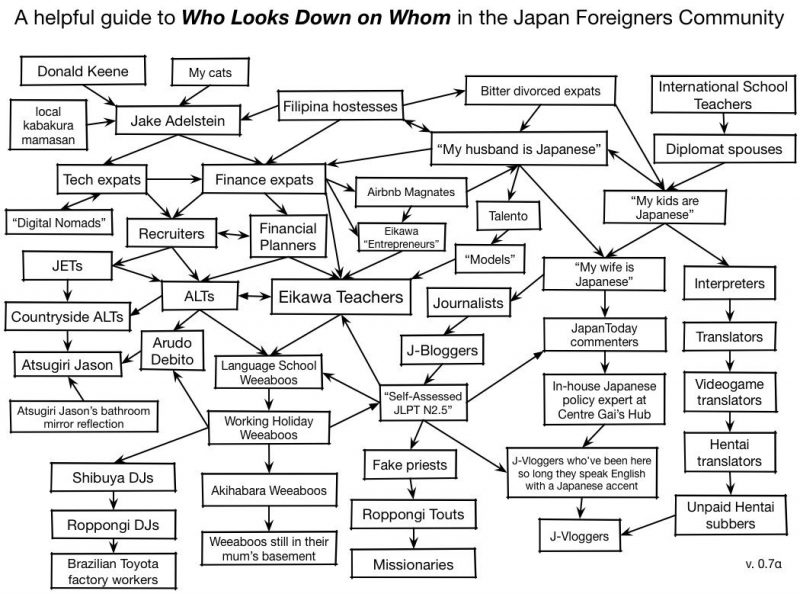
Yet the more hard-won the lessons we learn about the country, the more some of us realize how mundane life in Japan actually is. Specialty Kitkat chocolate bars, vending machines, Zen temples, and capsule hotels and trains that run on time are all just background noise and are totally unremarkable. Fax machines are actually still regularly used in many countries around the world, and not just in Japan. It's actually quite straightforward to take part in a supposedly insular culture.
Do you really need to learn Japanese to live in Japan? Like anything else in life, the correct answer to this question is entirely personal. At the end of the day, no matter where in the world you live, it's totally up to the individual whether life is mundane, rich with variety, or mysterious.
- May 7, 2019
- Comment (2506)
- Trackback(0)
Comment(s) Write comment
Thank you for keeping the writing honest and the points easy to verify against your own experience, and a stop at <a href="http://bloomcraftmarket.shop" />bloomcraftmarket</a> reflected the same approach, no exaggeration just steady useful content that I can take with me into my own work without second guessing every sentence I happen to read here.
-
DonaldLutty Web Site
- 21/7 10:44
Closed three other tabs to focus on this one and never opened them again, and a stop at <a href="http://linenwild.shop" />linenwild</a> similarly held attention exclusively, content that crowds out other reading from working memory is content with real density and this site has demonstrated that density across multiple pages I have visited so far this morning.
-
Noelthott Web Site
- 21/7 10:42
Reading this in the gap between work projects was a small but meaningful break, and a stop at <a href="http://windstonecollective.shop" />windstonecollective</a> extended that gentle reset, content that provides genuine refreshment rather than just distraction during work breaks is content with a particular kind of utility and this site fits that role for me reliably during work days.
-
LeonardOrels Web Site
- 21/7 10:36
Now thinking about whether the writer might publish a longer form work I would buy, and a look at <a href="http://businesspower.bond" />businesspower</a> suggested the same depth would translate, content that makes me want to pay for related work in other formats is content that has earned commercial trust as well as attention trust and this site has both clearly.
-
Walkernairl Web Site
- 21/7 10:35
Easy to recommend without reservations, the site delivers on every promise it implicitly makes, and a look at <a href="http://northloomgoods.shop" />northloomgoods</a> kept that same standard going, the kind of consistency that earns trust over time rather than chasing it through aggressive marketing is what I see here and it is appreciated greatly by this particular reader today.
-
ChrisAutow Web Site
- 21/7 09:59
Skipped the TLDR thinking I would read everything anyway, and ended up enjoying the path through the full post, and a stop at <a href="http://bondedhorizon.bond" />bondedhorizon</a> similarly rewarded the patient read, summaries are useful but the journey through good writing is part of what makes the destination feel earned rather than just delivered cleanly.
-
CadenWab Web Site
- 21/7 09:56
Looking at the surface design and the substance together this site has both right, and a look at <a href="http://capitalwatch.bond" />capitalwatch</a> reinforced that integrated quality, sites where presentation and content reinforce each other rather than fighting are sites with full editorial coherence and this one has clearly invested in both layers in a balanced way.
-
Lioneljible Web Site
- 21/7 08:52
Now planning to come back when I have the right kind of attention to read carefully, and a stop at <a href="http://progresscatalyst.bond" />progresscatalyst</a> reinforced that plan, choosing the right moment to read certain content is a quiet form of respect for the work and this site is generating those careful planning behaviours from me consistently as a reader.
-
KeithAcera Web Site
- 21/7 08:44
Came in for one specific question and got answers to three I had not even thought to ask, and a look at <a href="http://sunhavenoutlet.shop" />sunhavenoutlet</a> extended that bonus value pattern, the kind of resource that anticipates reader needs rather than just answering the literal question asked is the gold standard and this site reaches it.
-
CharlesCok Web Site
- 21/7 07:56
A welcome reminder that thoughtful writing still happens online, and a look at <a href="http://bondedvector.bond" />bondedvector</a> extended that reassurance, the modern web makes it easy to forget that careful writing exists and finding sites that practice it is a small antidote to the cynicism that builds up from too much exposure to algorithmic content.
-
WarrenLic Web Site
- 21/7 07:54
Felt the post had been written without looking over its shoulder, and a look at <a href="http://frontierbond.bond" />frontierbond</a> continued that confident posture, content written for its own sake rather than against imagined critics has a different quality and this site reads as written from a place of confidence rather than defensive justification of every claim.
-
EvanENUPS Web Site
- 21/7 07:52
Reading this slowly because the writing rewards a slower pace, and a stop at <a href="http://emberwildstore.shop" />emberwildstore</a> did the same, the pace at which I read content is something I now use as a quality signal and writing that earns a slower pace earns my attention as a reader looking for substance these days.
-
Yaleber Web Site
- 21/7 07:42
Excellent execution from start to finish, the post never loses its rhythm and the points stay sharp, and a quick stop at <a href="http://covebeck.shop" />covebeck</a> kept the same level going, consistency like this across a site is the marker of a serious operation rather than a casual side project running on autopilot somewhere else.
-
SteveFus Web Site
- 21/7 07:42
Will be passing this along to a few people who would benefit from the perspective shared here, and a stop at <a href="http://silverlinebond.bond" />silverlinebond</a> only added to what I will be sharing, this kind of generous content deserves to circulate widely rather than getting buried in some search engine algorithm tweak that pushes it down the rankings.
-
Brucelah Web Site
- 21/7 07:37
Benlal Web Site- 21/7 10:51