

▼ Mindful Care: Changing The Perception of Mental Health in Japan
- Category:Other
TOKYO - Japan has long been known as a place where discussion of mental health is taboo. But this is beginning to change. The number of mental health professionals—including clinical psychologists—is growing, care is expanding to a wider range of issues, and environments for treatment are becoming more comfortable.
LONG VIEW
It takes time for societal views to evolve, and Andrew Grimes is a clinical psychologist who has witnessed this firsthand. He first came to Japan 32 years ago and began working as an English teacher. One of his students had two children with mental disabilities, and he volunteered to help them. This decision would lead to a career in healthcare and the establishment of his own business.
Inspired by the work of his mentor, Dr. Noboru Hozumi, Grimes opened Tokyo Counseling Services (TCS) in 1999. “At first it was just me, an answering machine, and three empty rooms,” he laughed. But things grew, and, in 2003, he became the only non-Japanese mental health professional to be awarded qualification as a registered psychotherapist in Japan by the Japanese Federation for Psychotherapy.
And in autumn 2007, he opened TCS’s first purpose-designed counseling center in the heart of Shimokitazawa, a popular neighborhood in Tokyo’s Setagaya Ward.
Today, TCS has 20 counselors and offers services seven days a week, logging about 100 case hours during that period.
Grimes recalls some of the initial difficulties he faced when starting the center, admitting that for the first two or three years it was difficult to build a client base. “This was simply because the numbers did not generate enough income to cover the running of the center,” he said.
Using borrowed money, he was able to bring the business towards the black. But the 2008 Lehman Shock and the Great East Japan Earthquake and Tsunami of March 2011 squashed any dreams of quick, continued growth. Eight years later, Grimes feels that the business is finally stable.
“We are very secure now, and we are getting new clients weekly. I’m feeling quite satisfied now that I have achieved my goals to have a functioning, full counseling center.”
Another obstacle he faced when opening the clinic was the perception Japanese people had of him and his counselors. “People had an idea that somehow we were English teachers,” he said. “The older generations were very much of the mindset that a non-Japanese person could not counsel a Japanese person.”
But that perception is gone, and the center now has counselors who work in English, Japanese, French, German, Korean, and Mandarin.
SOCIAL SHIFT
The view of mental health in Japanese society was one of the highest hurdles in years past. Grimes explained that many saw counseling as “a place where crazy people go.” This has changed over the past decade. “Now, it’s much more acceptable in society to say that you are seeing a psychiatrist or counseling center,” he said.
The range of recognized disorders and treatments is also growing. Post-traumatic stress disorder (PTSD) is just one such mental health issue that is finally being acknowledged and treated. Others include depression, bipolar disorder, and schizophrenia.
“Primarily, we are seeing people with depression, PTSD, social anxiety disorder, and panic attacks,” Grimes said. “And we have increased couples counseling quite dramatically. At least 20 percent of our clients are couples.”
Grimes emphasized that, despite some naysayers, mental healthcare services in Japan have undergone huge changes, and the stigma of going to a psychiatric clinic or a counseling center has lessened.
DIGITAL DIVIDE
The majority of TCS’s patients are in their forties to sixties, but Grimes is seeing more and more young people seeking help. This, he says, is a major change.
One reason for the growth in counseling needs among youth, he believes, is online activity. “I think there is an influence of social media, that people are forming friendships on Facebook, Twitter, and various platforms, and it’s causing anxiety because people are not going out to meet as much.
Therefore, they are not developing their social skills and are experiencing high anxiety. As a result, panic attacks and depression are on the increase.”
Many of the young patients at TCS suffer from depression—and it almost always stems from life online. “It’s a very sensitive medium. You put up personal things about yourself and people write nasty comments. It is easy to be vilified,” Grimes said.
He is hopeful that the tide will turn, and there are now professional associations and societies that are researching and addressing the effects of social media.
CULTURAL CONCERN
Another cause of stress for young people in Japan is the pressure to find jobs. “We’ve come to a schism whereby the parents’ influence on the child and what kind of job they would go for is very strong,” Grimes said. “There are more and more young people who do not want lifetime employment.
“I want to be optimistic that the growth of problems can be matched by the growth in the provision of professional mental healthcare. For example, at the current time, there are more than 30,000 clinical psychologists in Japan. That does surprise people.” In addition to these specialists, there are more than 100,000 mental healthcare professionals in the Kanto and Kansai regions.
“There has got to be a shift away from the old mentality,” he said. “People must be able to go for mental healthcare without it affecting the image they have at work.”
The situation is beginning to change. Employment assistance programs (EAPs) are rising, and these companies are forming contracts with large corporations. However, Grimes added, this very much depends on the company.
“The more liberal companies are taking onboard EAPs, or simply just encouraging employees to seek help, and the human resources department is very instrumental in that.”
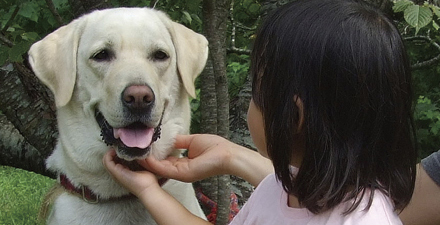
A working dog at an Apricot picnic in Tanohata, Iwate Prefecture.
APRICOT
Despite the improved situation in many regions—specifically in Tokyo—mental healthcare professionals and facilities are still lacking in Tohoku and countryside areas. Grimes founded the 100-percent volunteer project Apricot (Allied Psychotherapy Relief Initiative for the Children of Tohoku) in 2012 to act as a conduit to gather funds to enable mental healthcare professionals to provide assistance to the region. Non-profit organization (NPO) status was granted by the Tokyo Metropolitan Government in October 2014.
“Having to overcome a lack of knowledge about mental healthcare and how to use educational programs with local community nurses and teachers is the main thing that Apricot and other NPOs struggle with,” Grimes said.
After the 2011 earthquake, as international aid was reallocated, Grimes realized there was a pressing need in the region.
In the wake of these tragedies, more than 71,000 children and mothers were evacuated from Fukushima Prefecture’s eastern districts, and government surveys found that 1 in 3 of these children suffered mental health issues following the experience.
“I decided the best thing we could do is gather as much funding and try to encourage people to have more corporate social responsibility (CSR),” he said.
All funds raised by Apricot go to carefully vetted organizations such as the disaster relief mental health committees of the Japan Society of Certified Clinical Psychologists and Fukushima Society of Certified Clinical Psychologists. But getting sponsorship and help from Japanese companies has been difficult. Many are only slowly beginning to embrace CSR.
They have had some success with the likes of the Embassy of Belgium in Japan, where they held an event at which Japanese and global companies set up stalls to sell their goods. Profits were donated to Apricot.
Although the issue has faded from the news, the work goes on. Grimes continues to promote the NPO and find sponsorship. “What I am trying to do through LinkedIn is keep promoting CSR, and to try and get sponsorship from large corporations.”
He noted that, as seven years have now passed since the disasters, it is becoming more and more difficult to get donations. The public does not realize that, when it comes to mental health, the immediate aftermath is not the only concern. One of the challenges that the charity and mental health professionals face is ensuring continued care for those affected in the area. And that takes money.
THE FUTURE
While corporate support has been sparse, there are individuals who have made great contributions to the charity. Grimes names one man who is planning to handcycle around Japan to raise money, and he hopes that there will be more like him.
For Tokyo Counseling Services, the business has room to grow as mental health issues are increasingly acknowledged in Japan. Grimes hopes to expand to five rooms and maintain financial stability.
“We have got to a level of busyness that means, one day, we are going to have to tell somebody that we can’t help them; and I don’t ever want to have to say that to someone.”
Custom Media publishes The ACCJ Journal for the American Chamber of Commerce in Japan.
LONG VIEW
It takes time for societal views to evolve, and Andrew Grimes is a clinical psychologist who has witnessed this firsthand. He first came to Japan 32 years ago and began working as an English teacher. One of his students had two children with mental disabilities, and he volunteered to help them. This decision would lead to a career in healthcare and the establishment of his own business.
Inspired by the work of his mentor, Dr. Noboru Hozumi, Grimes opened Tokyo Counseling Services (TCS) in 1999. “At first it was just me, an answering machine, and three empty rooms,” he laughed. But things grew, and, in 2003, he became the only non-Japanese mental health professional to be awarded qualification as a registered psychotherapist in Japan by the Japanese Federation for Psychotherapy.
And in autumn 2007, he opened TCS’s first purpose-designed counseling center in the heart of Shimokitazawa, a popular neighborhood in Tokyo’s Setagaya Ward.
Today, TCS has 20 counselors and offers services seven days a week, logging about 100 case hours during that period.
Grimes recalls some of the initial difficulties he faced when starting the center, admitting that for the first two or three years it was difficult to build a client base. “This was simply because the numbers did not generate enough income to cover the running of the center,” he said.
Using borrowed money, he was able to bring the business towards the black. But the 2008 Lehman Shock and the Great East Japan Earthquake and Tsunami of March 2011 squashed any dreams of quick, continued growth. Eight years later, Grimes feels that the business is finally stable.
“We are very secure now, and we are getting new clients weekly. I’m feeling quite satisfied now that I have achieved my goals to have a functioning, full counseling center.”
Another obstacle he faced when opening the clinic was the perception Japanese people had of him and his counselors. “People had an idea that somehow we were English teachers,” he said. “The older generations were very much of the mindset that a non-Japanese person could not counsel a Japanese person.”
But that perception is gone, and the center now has counselors who work in English, Japanese, French, German, Korean, and Mandarin.
SOCIAL SHIFT
The view of mental health in Japanese society was one of the highest hurdles in years past. Grimes explained that many saw counseling as “a place where crazy people go.” This has changed over the past decade. “Now, it’s much more acceptable in society to say that you are seeing a psychiatrist or counseling center,” he said.
The range of recognized disorders and treatments is also growing. Post-traumatic stress disorder (PTSD) is just one such mental health issue that is finally being acknowledged and treated. Others include depression, bipolar disorder, and schizophrenia.
“Primarily, we are seeing people with depression, PTSD, social anxiety disorder, and panic attacks,” Grimes said. “And we have increased couples counseling quite dramatically. At least 20 percent of our clients are couples.”
Grimes emphasized that, despite some naysayers, mental healthcare services in Japan have undergone huge changes, and the stigma of going to a psychiatric clinic or a counseling center has lessened.
DIGITAL DIVIDE
The majority of TCS’s patients are in their forties to sixties, but Grimes is seeing more and more young people seeking help. This, he says, is a major change.
One reason for the growth in counseling needs among youth, he believes, is online activity. “I think there is an influence of social media, that people are forming friendships on Facebook, Twitter, and various platforms, and it’s causing anxiety because people are not going out to meet as much.
Therefore, they are not developing their social skills and are experiencing high anxiety. As a result, panic attacks and depression are on the increase.”
Many of the young patients at TCS suffer from depression—and it almost always stems from life online. “It’s a very sensitive medium. You put up personal things about yourself and people write nasty comments. It is easy to be vilified,” Grimes said.
He is hopeful that the tide will turn, and there are now professional associations and societies that are researching and addressing the effects of social media.
CULTURAL CONCERN
Another cause of stress for young people in Japan is the pressure to find jobs. “We’ve come to a schism whereby the parents’ influence on the child and what kind of job they would go for is very strong,” Grimes said. “There are more and more young people who do not want lifetime employment.
“I want to be optimistic that the growth of problems can be matched by the growth in the provision of professional mental healthcare. For example, at the current time, there are more than 30,000 clinical psychologists in Japan. That does surprise people.” In addition to these specialists, there are more than 100,000 mental healthcare professionals in the Kanto and Kansai regions.
“There has got to be a shift away from the old mentality,” he said. “People must be able to go for mental healthcare without it affecting the image they have at work.”
The situation is beginning to change. Employment assistance programs (EAPs) are rising, and these companies are forming contracts with large corporations. However, Grimes added, this very much depends on the company.
“The more liberal companies are taking onboard EAPs, or simply just encouraging employees to seek help, and the human resources department is very instrumental in that.”
A working dog at an Apricot picnic in Tanohata, Iwate Prefecture.
APRICOT
Despite the improved situation in many regions—specifically in Tokyo—mental healthcare professionals and facilities are still lacking in Tohoku and countryside areas. Grimes founded the 100-percent volunteer project Apricot (Allied Psychotherapy Relief Initiative for the Children of Tohoku) in 2012 to act as a conduit to gather funds to enable mental healthcare professionals to provide assistance to the region. Non-profit organization (NPO) status was granted by the Tokyo Metropolitan Government in October 2014.
“Having to overcome a lack of knowledge about mental healthcare and how to use educational programs with local community nurses and teachers is the main thing that Apricot and other NPOs struggle with,” Grimes said.
After the 2011 earthquake, as international aid was reallocated, Grimes realized there was a pressing need in the region.
In the wake of these tragedies, more than 71,000 children and mothers were evacuated from Fukushima Prefecture’s eastern districts, and government surveys found that 1 in 3 of these children suffered mental health issues following the experience.
“I decided the best thing we could do is gather as much funding and try to encourage people to have more corporate social responsibility (CSR),” he said.
All funds raised by Apricot go to carefully vetted organizations such as the disaster relief mental health committees of the Japan Society of Certified Clinical Psychologists and Fukushima Society of Certified Clinical Psychologists. But getting sponsorship and help from Japanese companies has been difficult. Many are only slowly beginning to embrace CSR.
They have had some success with the likes of the Embassy of Belgium in Japan, where they held an event at which Japanese and global companies set up stalls to sell their goods. Profits were donated to Apricot.
Although the issue has faded from the news, the work goes on. Grimes continues to promote the NPO and find sponsorship. “What I am trying to do through LinkedIn is keep promoting CSR, and to try and get sponsorship from large corporations.”
He noted that, as seven years have now passed since the disasters, it is becoming more and more difficult to get donations. The public does not realize that, when it comes to mental health, the immediate aftermath is not the only concern. One of the challenges that the charity and mental health professionals face is ensuring continued care for those affected in the area. And that takes money.
THE FUTURE
While corporate support has been sparse, there are individuals who have made great contributions to the charity. Grimes names one man who is planning to handcycle around Japan to raise money, and he hopes that there will be more like him.
For Tokyo Counseling Services, the business has room to grow as mental health issues are increasingly acknowledged in Japan. Grimes hopes to expand to five rooms and maintain financial stability.
“We have got to a level of busyness that means, one day, we are going to have to tell somebody that we can’t help them; and I don’t ever want to have to say that to someone.”
Custom Media publishes The ACCJ Journal for the American Chamber of Commerce in Japan.
- September 6, 2018
- Comment (34813)
- Trackback(1)
Comment(s) Write comment
precio del is farmacias
6ff1 benta is sin receta
6ff1 the cheapest is online
6ff1
6ff1 benta is sin receta
6ff1 the cheapest is online
6ff1
-
LinaReddy Web Site
- November 10, 2020
cc0011 click now generic price viagra
<a href="http://viagener2020.com/">viagra</a>free viagra samples online
<a href="http://viagraaqwe.com/">buy viagra online</a>il viagra generico
<a href="http://viagraeuw.com/">buy viagra</a>
<a href="http://viagener2020.com/">viagra</a>free viagra samples online
<a href="http://viagraaqwe.com/">buy viagra online</a>il viagra generico
<a href="http://viagraeuw.com/">buy viagra</a>
-
LinaReddy Web Site
- November 10, 2020
cc0021 super viagra 100mg
[url=http://viagener2020.com/]viagra online[/url]
can you buy viagra indonesia
[url=http://viagraaqwe.com/]viagra[/url]
viagra dure combien de temp
[url=http://viagraeuw.com/]buy viagra[/url]
[url=http://viagener2020.com/]viagra online[/url]
can you buy viagra indonesia
[url=http://viagraaqwe.com/]viagra[/url]
viagra dure combien de temp
[url=http://viagraeuw.com/]buy viagra[/url]
-
LinaReddy Web Site
- November 10, 2020
para que sirve el is jet
6ff1 dennis female is
6ff1 is logo download
6ff1
6ff1 dennis female is
6ff1 is logo download
6ff1
-
LinaReddy Web Site
- November 10, 2020
cc0031 viagra tablets london
http://viagener2020.com/ price of one tablet of viagra
http://viagraaqwe.com/ price of levitra vs viagra
http://viagraeuw.com/
http://viagener2020.com/ price of one tablet of viagra
http://viagraaqwe.com/ price of levitra vs viagra
http://viagraeuw.com/
-
LinaReddy Web Site
- November 10, 2020
is pfizer thailand
6ff1 phone prescription is
6ff1 female is review uk
6ff1
6ff1 phone prescription is
6ff1 female is review uk
6ff1
-
LinaReddy Web Site
- November 10, 2020
cc0021 viagra ag
[url=http://viagener2020.com/]viagra without doctor prescription[/url]
viagra kaufen in nurnber
[url=http://viagraaqwe.com/]viagra cheap[/url]
the viagra for diane brain
[url=http://viagraeuw.com/]generic viagra online[/url]
[url=http://viagener2020.com/]viagra without doctor prescription[/url]
viagra kaufen in nurnber
[url=http://viagraaqwe.com/]viagra cheap[/url]
the viagra for diane brain
[url=http://viagraeuw.com/]generic viagra online[/url]
-
LinaReddy Web Site
- November 10, 2020
yahoo answers is online
6ff1 how to get is online
6ff1 try it is on women
6ff1
6ff1 how to get is online
6ff1 try it is on women
6ff1
-
LinaReddy Web Site
- November 10, 2020
cc0021 i recommend cheap india viagra
[url=http://viagener2020.com/]cheap viagra[/url]
costo viagra generico farmacia
[url=http://viagraaqwe.com/]cheap viagra[/url]
we recommend woman and viagra
[url=http://viagraeuw.com/]buy viagra online[/url]
[url=http://viagener2020.com/]cheap viagra[/url]
costo viagra generico farmacia
[url=http://viagraaqwe.com/]cheap viagra[/url]
we recommend woman and viagra
[url=http://viagraeuw.com/]buy viagra online[/url]
-
LinaReddy Web Site
- November 10, 2020
be is greece here
9831 is barato sper
9831 be is cheap at
9831 is australia paypal
9831
9831 is barato sper
9831 be is cheap at
9831 is australia paypal
9831
-
TeraultReddy Web Site
- November 10, 2020
issuperactive
9831 we choice is uk chemist
9831 best is at pills
9831 we choice at is sale
9831
9831 we choice is uk chemist
9831 best is at pills
9831 we choice at is sale
9831
-
TeraultReddy Web Site
- November 10, 2020
whyisissoexpensive
9831 be at is in mexico
9831 cheap is 5mg uk
9831 il is acquisto in svizzera
9831
9831 be at is in mexico
9831 cheap is 5mg uk
9831 il is acquisto in svizzera
9831
-
TeraultReddy Web Site
- November 10, 2020
is is packages
9831 is es que toma se el y
9831 be soft is toronto
9831 is 20mg notice
9831
9831 is es que toma se el y
9831 be soft is toronto
9831 is 20mg notice
9831
-
TeraultReddy Web Site
- November 10, 2020
1fd021 viagra connecticut
[url=http://vigraweuy.com/]buy viagra[/url]
we use it viagra prices in usa
[url=https://cheapandbestonline20.com/]buy viagra[/url]
cheap cialis 5mg uk
[url=https://cia20online.com/]buy cialis online[/url]
soft tab cialis
[url=https://cialisactivesupers.com/]buy cialis online[/url]
[url=http://vigraweuy.com/]buy viagra[/url]
we use it viagra prices in usa
[url=https://cheapandbestonline20.com/]buy viagra[/url]
cheap cialis 5mg uk
[url=https://cia20online.com/]buy cialis online[/url]
soft tab cialis
[url=https://cialisactivesupers.com/]buy cialis online[/url]
-
TeraultReddy Web Site
- November 10, 2020
Trackback (You need to login.)
http://www.yeezy-shoes.in.net/ Yeezy Shoes
- Nike Air Force 1
- July 30, 2020
http://viagener2020.com/ viagra at cvs price
http://viagraaqwe.com/ try it viagra on women
http://viagraeuw.com/
LinaReddy Web Site- November 10, 2020